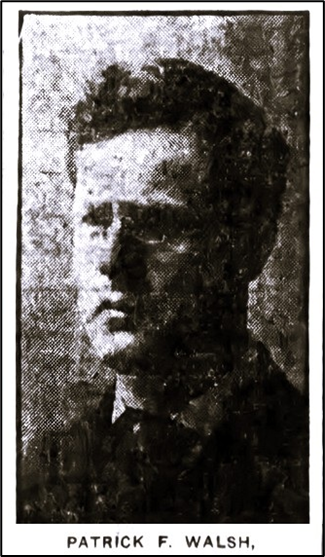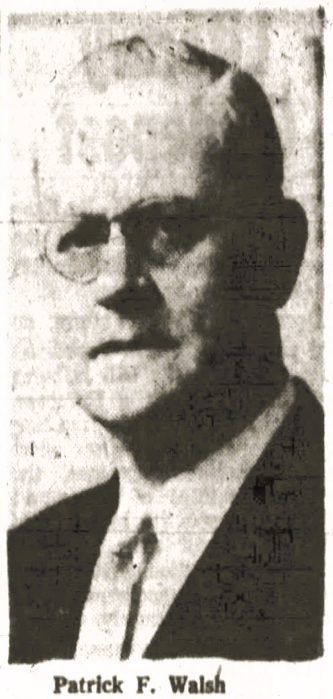
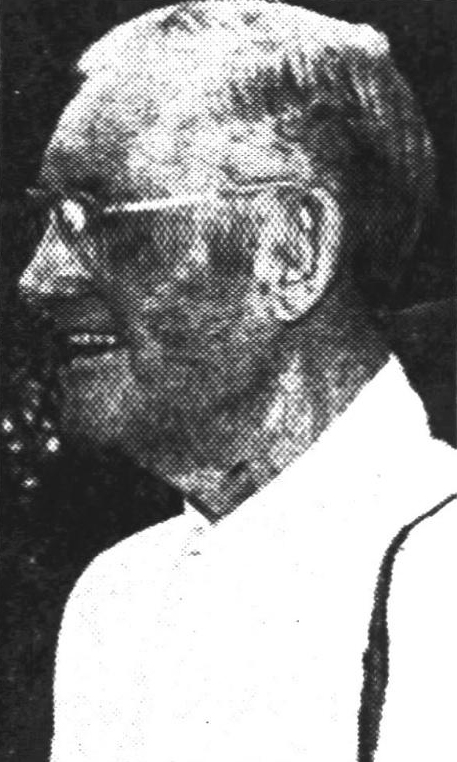
Patrick Francis Walsh (1870-1958) was born in St Clair, Schuylkill County, Pa., one of 13 children of Michael Walsh Junior and Jane Jones. He married Margaret Kearney of Scranton in 1916 and they had a daughter, Marjory.
He was working as a company miner at the Pennsylvania Coal Co. #14 Colliery at Inkerman, Jenkins Township, Luzerne County August 22, 1907. The No. 14 Colliery was situated about halfway between Plainsville and Port Blanchard and got its name from the 14 veins that are mined. Thomas Price (1809-1877), a Welsh immigrant, is regarded by some historians as being the first man to engage in underground mining in Pittston. He opened the Blanchard Mine in the Port Blanchard section of Jenkins Township in 1833. That mine would later be part of the No. 14 Colliery. The colliery was worked by slope, drift, and shaft openings, mining the Hillman, Diamond, Checker, Pittston, Marcy, Clark, and Red Ash seams. In 1907, there were 879 men and boys working inside. The Colliery’s mine openings were all located some distance from the breaker.
The No 14 Tunnel, one of the openings on the hillside above Port Blanchard, had been driven from the Pittston vein up to the Diamond vein and a number of places in the tunnel, were “working” with roof and coal dropping often. The necessary retimbering work, taking out the old timbers and putting new ones in their place, couldn’t be done while the drivers were going and coming with their trips of coal from the Diamond vein. The inside foreman had taken the miners out of the Diamond Vein and had a double shift of 17 men on the timbering to hurry up the job so that the miners could get back to work. The men were placing what were known as “cog pillars,” interlacing ties laid horizontally, because of the caving in the upper Checker vein and the thin roof above the Diamond.
At about 2 P. M., a five-man timbering crew were preparing places to put the timber in, an extensive cave-in suddenly occurred, covering Peter Flynn, Irish, company laborer; James O’Boyle, Irish, company miner; Joseph Griglar, German, company miner; and James Koneig, German, company miner, who were entombed and killed by the caving; and John H. Eustice, an American timberman who weighed some 300 pounds was caught in the fall.
News of the fall reached the outside and a rescuing crew of some sixty men led by General Superintendent William Wallace Inglis (1871-1953) was formed. George R. Jopling, 55 and John Merrick, 50, pillar bosses who were part of the timbering crew; Patrick F. Walsh, 29, company miner; Benjamin J. George, 26, assistant mine foreman; and Thomas Huntley, 40 the outside foreman joined the rescue party.
Extra timber pillars were built to prevent additional caves and protect the rescuers. The Pittston Gazette reported, “a workman said, ‘a veritable forest has gone into the tunnel since last night.’ Mine car after mine cars loaded with props were sent in in an almost continual line. A force of men was kept busy sending in the timbers and taking care of the empty cars.” Hand work removing the caved rock itself was also extremely laborious. John Eustice’s voice could be heard all the time, urging, “I’m caught here. Hurry and help get us out!”
About 4 hours after the cave, Walsh, Huntley, Jopling, Merrick, and George, reached the area where Eustice was caught. They had to climb up on the six-foot high cave, across about twenty-five feet to reach Eustice, and work with picks and shovels for three hours to move the caved rock and coal. Eustice was caught under a portion of the cave by one leg with a fractured thigh, and they had to work with the utmost care to release him. Finally, they were able to drag him from behind the slab which had pinned him down, and the rescuers carried him to safety. He recovered from the broken leg, but died in 1914 from “complications, traced to the shock of being entombed”.
A few minutes after Eustice was rescued a second cave-in took place and all hope of rescuing Boyle and Flynn, who were farther in the gangway, was abandoned, as the pillars and roof in both veins were working heavy and required immediate attention to protect those who were working to rescue the men under the rock. The bodies of O’Boyle and Flynn were recovered August 29, and the bodies of Koenig and Griglar were recovered September 1 and 6. The indications were that Koenig and Griglar had been instantly killed by the fall
The rescue effort was referred to the Carnegie Fund by William Paul Jennings, Pittston Division Superintendent and two others. In November 1910, Patrick Walsh was awarded a bronze medal and $1,000 for his efforts in saving Eustice’s life. His fellows were also added to the roll of honor and awarded bronze medals for their efforts.
At age 10, Walsh’s father was a coal miner, his oldest brother “worked in a mine” and Walsh and a younger brother “worked in a breaker.” Walsh left the mines for a year to serve in the Army during the Spanish American War. He served in Company A of the Ninth Pennsylvania Volunteer Infantry, from Luzerne County. The unit reported for training at Camp Hastings, Mount Gretna, Lebanon County, on April 28, 1898, and was mustered into the federal service in May 1898. It was ordered south, to Camp Thomas, Georgia the former Civil War battlefield of Chickamauga, Georgia. They moved to Camp Hamilton, Kentucky in August, after the armistice had been signed and were mustered out of the service at the end of October. The Pennsylvania Volunteers lost 27 men to disease during their service. By 1900, his father had left the mines and his 15-year-old brother Martin was a driver in the mine, and Patrick and his 19 year-old brother Ed were both mine laborers.
Ed would soon be known as the Chicago White Sox Hall of Fame pitcher “Big Ed” Walsh, who would have his best year in baseball in 1908. In 1908 Ed put together a masterpiece, compiling 40 wins against just 15 losses, a 1.42 ERA, including a league record-breaking 11 shutouts, and 464 innings pitched. Ed was the last 40-win and last 400+ pitch pitcher in Major League Baseball. Brother Martin also pitched in the Major Leagues.
Patrick was discharged by Pennsylvania Coal Company for union activities two weeks before the announcement of the award, and he was working as an assistant fire boss for the Lehigh Valley Coal Company. Walsh became an organizer for the United Mine Workers in 1916 for about six years. Later in life he was an usher in the Scranton Comerford theater.
He died February 20, 1958, in Newton, Lackawanna County, Pa., and was buried at the Cathedral Cemetery in Scranton.