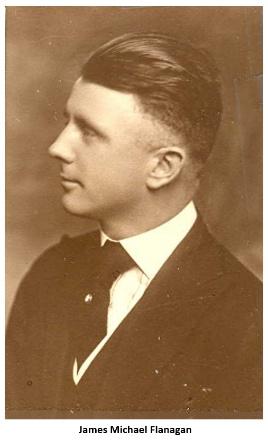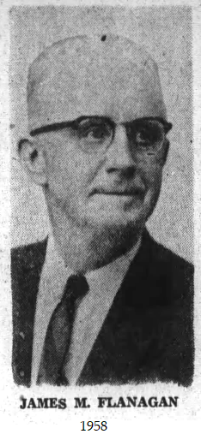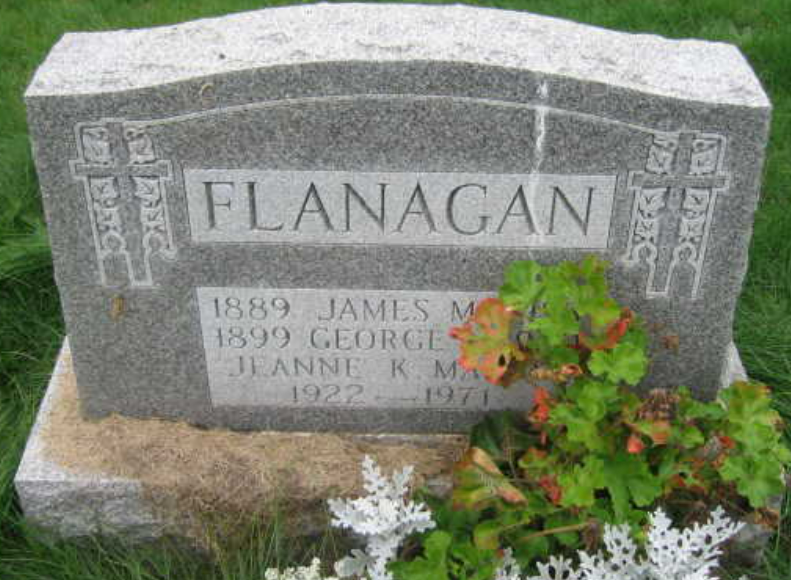
James Michael Flanagan (1891-1958) was born in Pittston, one of three children of Michael Flanagan and Catherine Vangeline Loftus. He married Katheryn McDonald of Pittston in 1920 and they had five children.
He was working as a mule driver at the Pennsylvania Coal Company Inkerman No.6 Colliery, just east of Inkerman, Pa. The Pennsylvania Coal Company built a new No. 6 breaker at Inkerman in 1898. About 1,500,000 ft of lumber was used in its construction. The capacity of the breaker was 1,800 tons per day while the combined pocket room was about 1,500 tons. The coal prepared at this breaker was mined at Nos 5, 6, and 11 shafts, mining the Checker, Pittston, Marcy, Clark and Red Ash Seams. The company sunk No 6 shaft 557.7 feet, the deepest in the Pittston district. 1064 men and boys were working at No. 6 Colliery in 1909. On May 7, 1909, two of Flanagan’s co-workers were burnt by an explosion.
Flanagan, with William Derrig and John W. Mullery, company laborers were working with mules and mine cars dumping rock into headings from a haulage way of the Marcy vein of the No. 6 Shaft. Derrig and Mullery went into abandoned mine openings. There were various explanations as to why they went there, perhaps to get old equipment, to get mule chains, or perhaps to goof off. A mine official said they “had no reason to go into the workings”. Flames from their head lamps, “naked lamps,” ignited a gas feeder in the area, and the explosion caused serious burns on both men and Mullery’s leg was broken.
19-year-old Flanagan, who was working about 1500 feet from the explosion, realized that they might die from afterdamp and tried to get help to go after the two. And after failing to find helpers, he went into the gangway alone. He ran some distance toward the scene of the explosion but encountered air so bad that he put his coat over his head and face to avoid being overcome. Flanigan went into the abandoned drift about a quarter of a mile in the dark, fearing his light might rekindle the gas. He finally found both unconscious men. Derrig’s clothing was on fire, and Flanagan extinguished it, tearing the clothing from Derrig’s, body and helped the now-conscious Derrig to walk to a safe place.
Flanagan returned to the abandoned openings and carried Mullery to safety. When the mine first aid corps arrived, it found three men needing help. Flanagan was badly burnt from extinguishing the flames, and weak from exhaustion after his efforts in the bad air. He was disabled for eighteen days. Mullery was taken to his parent’s home where he recovered, he returned to the mines and lived until 1941. Derrig was taken to the Pittston hospital where he died several days later.
Flanagan said, “I have nothing to say except that when the wind knocked me down, I knew an explosion had taken place. I also knew my friends were in it, and I hurried to them and got them out as best I could. I simply did what any other fellow would have done for a friend – tried to save him.
Friends and newspapers began campaigning for Flanagan’s story to presented to the Carnegie Fund within the month, Pittston Mayor William H. Gillespie and Mullery’s brother James nominated him, and in November 1910, James Michael Flanagan was awarded a bronze medal and $1000 from the Carnegie Fund.
James’ father Michael died April 8, 1910, in Pittston, and his mother convinced him to move to Somerville, Massachusetts, where he worked for the Boston Elevated Railway Company, where he learned the electician’s trade. In 1911, the BERy built a large generating station in South Boston which produced 25 Hertz alternating current, which could be transmitted long distances at high voltage, to substations which would drop the voltage and convert it to direct current for use by trains.
Flanagan served in the army overseas in 1918 and 1919 in the 305th Trench Mortar Company and engaged the enemy at Verdun and Argonne. He received a Purple Medal when he was gassed and wounded October 11, 1918, in the Meuse–Argonne battle. He was discharged in April 1919. He returned to Pittston, buying a house with the Carnegie stipend in 1923. By 1920 he had returned to the mines, working first as a miner and then as an electrician. He worked at the Exeter Colliery for Payne Coal Company and at the Duryea Colliery for Kehoe-Barge before retiring in the 1950s.
Flanagan’s knack for doing a timely right thing kicked in again on an afternoon in December 1931 when he was walking down a street in Scranton, near the Moses Taylor Hospital.
Flanagan had been getting treatment at the hospital for the injuries he suffered in France, and was leaving the hospital when he noticed Mrs. Inez Martin, wife of a noted Scranton attorney M J Martin, clinging to her car door at the brink of a 30-foot deep subsidence of an abandoned Lackawanna Coal Company mine. He sprung into action and with help from another passerby was able to pull her to safety without serious injury.
James died of a heart attack May 13, 1958 and is buried in Saint John the Evangelist Cemetery, West Pittston.