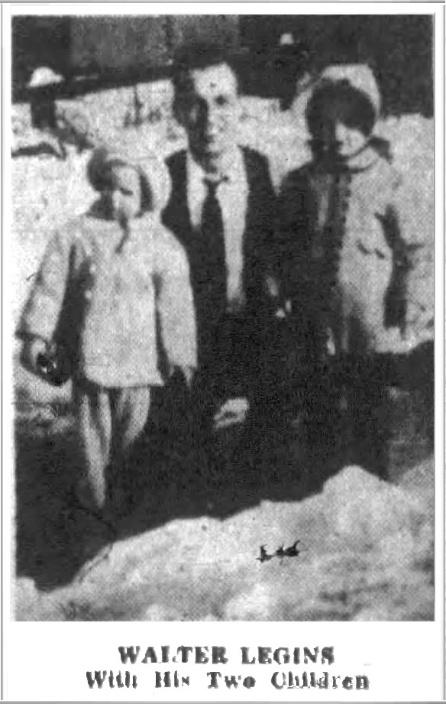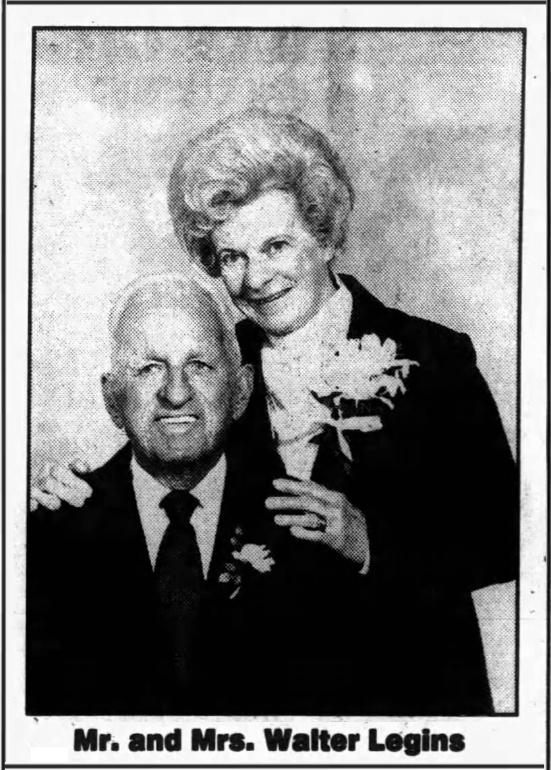
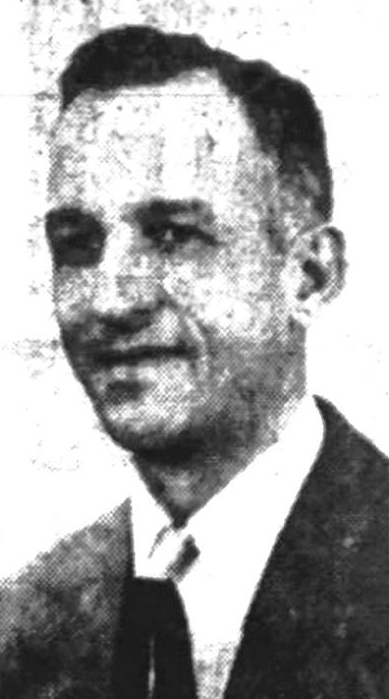
Walter Legins (1912-1998) was born in the Hanover section of Nanticoke, Luzerne County, PA, one of at least eleven children of Polish immigrants John Legins and Eva Janora. Walter married Sally Baran of Alden in 1940 and they had three children.
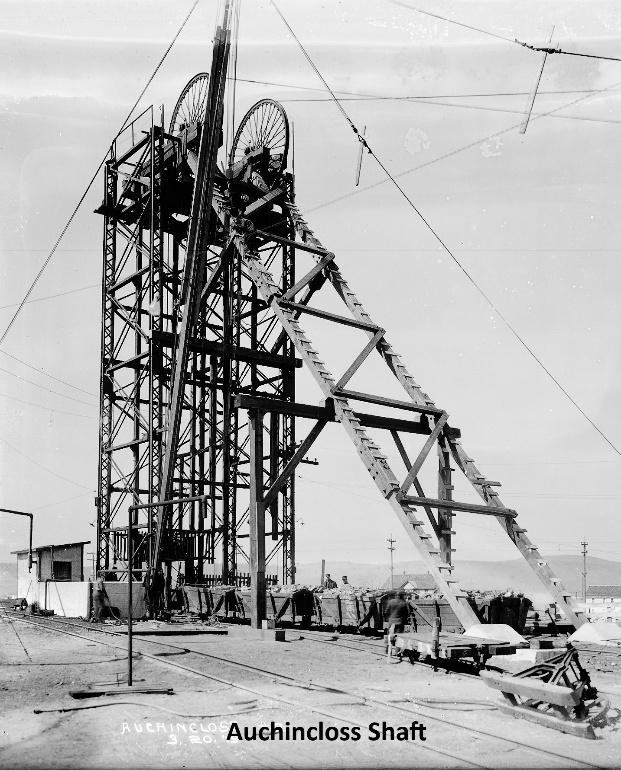
Walter was working in the Auchincloss Shaft of the Glen Alden Bliss Colliery on November 20, 1950 when an accident occurred. The Wilkes-Barre Times Leader / Evening News, December 15, 1950, published this account of Walter Legins’ brave acts on that night.
ALDEN MAN CITED AS MINE HERO, LOWERED 1100 FEET TO REACH VICTIM
Walsh Declares Act of Bravery at Auchincloss an Epic in Industry
Walter Legins of 77 East Kirmar Avenue, Alden Station, shaftman at the Bliss colliery of the Glen Alden Coal Company for the past six years, today was described by Deputy Secretary of Mines Joseph J. Walsh, as the hero of one of the most thrilling rescues in the history of the anthracite mining industry.
Legins gambled with death at the Auchincloss shaft and he won. This was on Monday night, November 20, when two shaftsmen were knocked from a scaffold on which they were working and plunged to their death.
A third man miraculously escaped similar fate by jumping to the cage suspended in the shaft close by. This third man, Stephen Grozio, was rescued by Legins, who was lowered 1,100 feet from the shaft with a rope tied about his waist.
The two men who lost their lives were Adam Ulanoski 46, of 42 Garfield street, Nanticoke, whose body was recovered earlier this week, and Warren Sargent, 34, of 269 Spring street, Nanticoke, for, whom rescuers are still searching. [Sargent’s body was recovered January 22.]
Secretary Walsh has described the circumstances surrounding the sensational rescue in the following circular letter sent to all mine inspectors, officials and miners:
“Never has it been known that anyone helplessly exposed to danger in a coal mine was left unaided. When faced with a rescue problem requiring human courage, the most dreadful dangers have never succeeded in preventing the heroic mine worker, who sets out to aid a fellow worker, from accomplishing his mission.’
“The striking truth of this statement was demonstrated recently at the Auchincloss shaft near Nanticoke, when tons of rock and timber fell from the sides of the shaft in which three men were making repairs. They were standing on platform more than 1100 feet below the surface. Two of the men, and the platform on which they stood, were swept to the bottom of the shaft 250 feet below. The third man, hearing the approach of the falling material, stepped on a cage, which was standing in an adjoining compartment, and escaped the fate suffered by his companions.
This third man, although saved from death, was in a most perilous position. The shaft was wrecked. Material was still falling. The cage upon which he stood being out of the guides, could be neither hoisted nor lowered.
“To save the life of the -man on the cage, help was needed. So here at the Auchincloss mine, when the alarm sounded: that a workman’s life was in danger–he being suspended in shaft wrecked by falling material every avenue of human ingenuity was opened to rescue him. Men of all ages and positions stood ready and willing to assist. However, only one could be used. Walter Legins, mine worker, of Alden, was lowered, by means of a rope, to the helpless man, 1100 feet below the surface of the earth. In this dangerous position, Legins assisted by the man he set out to rescue, skillfully adjusted the cage in the guides and both: were hoisted safely to the surface.
“The people of the mining region have reason to be proud and grateful for having in their midst men like Walter Legins. He has rendered a service to mankind which makes all of us his debtors.” After his deed of valor was made known to the public through the letter from the Department of Mines today, Mr. Legins was interviewed by a Times-Leader Evening News reporter.
The 38-year-old mine worker, father of two daughters, modestly answered questions which brought out some of the details of the heroic rescue. “They asked for volunteers,” he said, “and I. was chosen. I guess it Was because I was shaftman there for six years. Before that I was motor runner in the same mine for 13 years.
“I knew the shaft pretty well. But, after all, there was a man down there and he was calling for help. Someone had to get to him. There was no way to reach him except to be lowered by rope.
“They tied a three-quarter-inch hemp. rope around my waist and slowly they started me down the shaft. Before I started down I told my mine foreman, Dave Edwards, that he was the fellow I wanted to take whatever instructions I might want to give. Others were there, but there was too much talking and noise to take a chance on anyone or everyone. The only way I could get word to Dave, once I started down the shaft, was to holler to him. When I reached the point where the cage was stuck, he could just hear me and I could just hear him, but we both listened and got along alright.
“As I approached the stranded cage on which Stephen Grozio, shaftman, was held prisoner, I could hear him praying. called out, ‘Chubby, I’m coming down after you’ but I guess he couldn’t hear me. He continued praying. I could hear him say something about his mother, his wife and children.
“He was so grateful he couldn’t talk when I reached him. I asked him to give me hand in getting the cage back into the guides. At first, he was so frightened he hesitated to move. I told him it was too. much for one man and then we both pushed as the cage was lifted gently.
“Grozio and I were on top of the cage when it started to move slowly after I had called to Edwards to start up. Louis Cooper was the engineer, and he followed instructions relayed him by Edwards. We moved up about two feet when Lisaw foot that it would be best to drop back a for a fresh start. This didn’t exactly, please Edwards but he felt I knew what I was doing.
“In a matter of seconds, we started back up again. It was a slow ride. The moving cage loosened some of the material above us. I knew there was a chance of the whole thing coming in on us. Maybe that’s why small stones and bricks falling on us didn’t seem to hurt too much.
“At last we were at. the surface. Chubby grabbed me and kissed me. He knew he was safe then. Everybody was happy for us but we all knew that there were two more men at the foot of the shaft under tons of debris. We also felt sure that they were dead and at least they were not suffering.
“After a rest in the engine house and our nerves settled down, I told Daniel Thomas, colliery superintendent, about how things looked down there. I said it looked to me as if the two men were buried deep beneath timbers and rocks and it might be a month before they could be located. They got one of the men just the other day and they’re still looking for the other.”
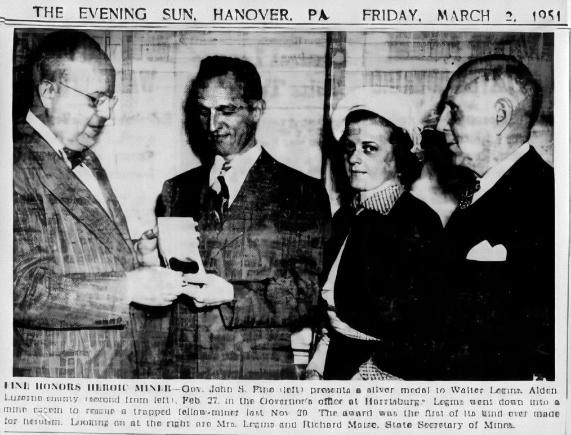
Pennsylvania Governor John Sydney Fine presented Legins with a silver medal on February 27, 1951. Reportedly, it was the first medal of its type ever made. Legins and his wife Sally, went to the governor’s office. “It’s especially nice to meet a hero from my home county,” Fine said as he chatted with Legins and his wife. Fine was born in Alden, Luzerne County, and from Nanticoke High School. Legins also was congratulated by Richard Maize, Secretary of Mines, who has suggested Legins for the special honor. “This is the first time we have ever made this award to a miner for an act of heroism,” Maize said. “We are proud to have miners like you in Pennsylvania.” The Joseph A. Holmes Safety Association awarded Walter a medal of honor in May. It was presented to him as part of the seventh annual Safety Day and First Aid contest of the Pennsylvania Anthracite Region in September 1951 at Irem Temple Country Club, Dallas, Pa. Legins was awarded the Carnegie Hero fund bronze medal in October 1951.
The Delaware Lackawanna & Western Coal Company built the Auchincloss and Bliss collieries on the southeast corner of Nanticoke. At the Auchincloss two shafts were sunk during 1892-1897 just northwest of South Prospect and Middle Road, on the grounds of today’s Luzerne County Community College Public Safety Training Institute. One each was sunk by renown local rock contractors, Joseph Pugh (1854-1904), Nanticoke and Henry Charles Perkins (1842-1899), Askam.
The Auchincloss shafts were near the southern end of what was the largest practically undeveloped area of coal land in the Wyoming-Lackawanna anthracite region. The deepest part of the Wyoming Valley coal measures is in this area, about 1 mile east of the City of Nanticoke. The structure of the Wyoming Basin is complex and the coal was mined to great depth. The shafts were notable for being the deepest then sunk in the anthracite region. The two shafts were 1,690 and 1,720 ft.. Nearby, in the Truesdale-Bliss Colliery, the Askam shaft had a surface elevation of +641 feet and a bottom elevation of -1492 feet, for a total depth of 2,133 feet.
The Auchincloss Breaker was the first anthracite breaker to be entirely operated by electricity. It began operation in 1903 and closed in 1919,with the colliery coal prepared at Loomis Breaker. The Delaware Lackawanna & Western was absorbed into the Glen Alden Coal Company in 1925. The Auchincloss Shaft and Bliss Colliery were merged about 1936, with both being part of the same UMWA local.
Walter had attended school through the seventh grade. He started work in the mines as a door tender before he was 17. He, his two older brothers and father all were working in the mines in 1930. In 1940 he was working as a brakeman at the Bliss Colliery. He related at the time of the accident he had been a motor runner for 13 years and a shaftman for six years.
Leggins received an Intermediate Mining Certificate from Nanticoke night school of the Mineral Industries Extension Services of Pennsylvania State College in 1952. Later that year passed the State qualification test for Assistant Mine Foreman. He appeared on the “Wheel of Fortune” radio and television program together with the man he rescued. Stephen Grozio of Hanover section of Nanticoke. October 3, 1952 on CBS network.
In a 1965 interview with the Times-Leader, he related that following the rescue of Grozio in 1950, Legins remained about the mines seven years and then took a job with years a construction company. He returned to the mines at Glen Alden’s Huber Colliery as a shaftman in 1960 and had been with the firm since. Grozio, Legins said, stayed with the Glen Alden Coal Company for a couple of years and then left to take another job. Grozio passed away in 1964. Before his retirement, he worked as a construction foreman for Glen Alden. He died January 24, at the Birchwood Nursing Home in Plains, Luzerne County, and is buried at St. Mary’s Cemetery, Hanover Township Luzerne County.