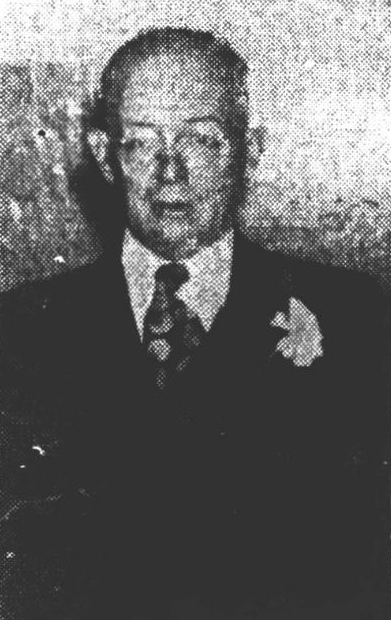
Henry William Eckley, Sr (1891-1951) was born in Shaft, a patchtown between Shenandoah and Lost Creek, also known as William Penn. He was one of five children of Henry H. Eckley and Hanna Draper. Henry H. was a coal miner and Hanna ran a candy store. Eckley married Nasser F Nora Blewis, a Polish immigrant living in William Penn, and they had six children.
Henry Eckley was working at George W. Ryon Coal Company Slope No. 1 Big Buck Vein mine, William Penn, part of the defunct William Penn Colliery Monday morning, April 16, 1951, Going to the assistance of Anthony Woznicki of Shenandoah cost Eckley his life. The veteran mine workers and former fire boss responded to a call for help from Woznicki.
Eckley raced up the chute in the No. 1 Slope where the injured miner was to help. Joseph Eckley, Henry’s brother, and Joseph Botsko, followed Mr. Eckley up chute. They found Woznicki lying about three feet from the working face of the chute. A large rock or lump of coal had fallen from overhead and fractured Woznicki’s back. While Botsko and Joseph Eckley hurried back down the chute to get a stretcher, Eckley stayed with thee injured man. Eckley went between Woznicki and the mine face, trying to move him and give him aid. While bent over the injured, another cave of roof and face occurred and partially buried both men. Eckley. He suffered a fractured right leg, contusions of the ribs and internal injuries. He remained unconscious after the accident and died at the Locust Mountain Hospital early on Thursday April 19. Woznicki would recover from his serious injuries and die in 1976
He was buried in Odd Fellows Cemetery, Shenandoah Heights, after a funeral from his home with employees of the Ryon Coal Company as pall bearers.
Samuel E. Griscom and Company obtained a lease on the Stephen Girard Estate in West Mahanoy Township in 1859. They erected a colliery on the property, which was called William Penn, after the founder of Pennsylvania. Extensive facilities were built by the firm, and it was due largely to Samuel Everett Griscom’s (1817-1904) management that the William Penn colliery became known as one of the leading collieries of the anthracite coal region. The William Penn Coal Company became the owner at the end of 1872, and they expanded the mine workings.
By October 1874, the mine was producing 20,000 tons of coal per month. During 1878, ownership William Penn Coal Company to Edward (1816-1878) and George Brooke (1818-1912) of Birdsboro, who retained the same name of the company. The property at this time was well developed and had three working lifts in the Mammoth vein and an inside slope driven into the Holmes vein. The only perpendicular shaft on the Girard Estate lands was located at this colliery. The company, under the ownership of George Brooke until 1892, continued production at a high rate and this colliery was the largest producer of anthracite on the Estate. Joseph Stickney (1840–1903) and William Lord Conyngham (1829-1907) acquired the lease for the Pennsylvania Coal Company and retained the same company name in 1892.
In 1892 the William Penn had an annual shipment close to half a million tons, employing more than 700 men and boys. The acquisition caused the opening of a new branch road from its terminal at the colliery as shipments had previously been made via the Reading. Management stayed the same, with William H. Lewis (1839-1918) remaining as the manager, as he had since 1872.
Susquehanna, Collieries Company acquired possession of the colliery in January, 1899. Under the Susquehanna Company management breakers were built and rebuilt in 1899, 1912 and 1923. They were also the first to adopt the “Safety First” slogan. On April 16, 1937, Pasquale “Tony Rose” Adonizio (1881-1954), a Pittston coal operator., took over colliery on a sub-lease from the Susquehanna Collieries Company, The men enjoyed steady working time for eight years and on August 7, 1945, Tony Rose terminated his lease. The colliery was again started in January of 1946 on a cooperative plan with employes making investments in the company. This failed and on the recommendation of District 9 President (UMWA) Joseph T. Kershetsky (1896-1978), the men voted to abandon the operation. The colliery closed June 11, 1947.
After the exit of Susquehanna, illegal mining, “coal bootlegging” had expanded on Girard Estates coal lands. Out of work miners worked small leasehold mines and illegal “bootleg” mines in the area, all close to the surface. The only work these men knew was mining, and with anthracite coal resting just a few feet below, it seemed only natural to them to avail themselves of this buried treasure, so they helped themselves, bootlegging. At first, they dug house coal to keep their homes warm, but often the bootlegging became businesses, and the illegally mined product was sold. Bootleg mining became an established industry by 1934 with an estimated total production in the anthracite area of two and one half million tons. By 1935, about 20,000 people were dependent upon this illegitimate trade for a living. The only work these men knew was mining, and with anthracite coal resting just a few feet below, they helped themselves, bootlegging. At first, they dug house coal to keep their homes warm, but often the bootlegging became businesses, and the illegally mined product was sold.
Clyde L. “Musty” Machamer, Sr. (1914-1989) organized a group of the “independent miners” in 1940 under the name of Miners, Breakermen and Truckers Association, and within two years it had a membership of 2500. In 1942, the membership had increased to 4,000 in west Schuylkill County and they produced more than four and one half million tons. The Association encouraged their members to try to lease land from the coal companies and landowners. Girard Estates hoped to control bootlegging by leasing properties to the “independent miners and made a lease agreement with George Wolfe Ryon Jr. (1892-1959) of Pottsville to supervise operation of all coal holes on Girard land in April 1947. The program granted independent miners several benefits under State and Federal Law and privileges under agreement with the United Mine Workers. The Shenandoah Evening Herald reported in June 1948, “Since Mr. Ryon has assumed charge at William Penn a cordial feeling exists between the lessees and lessor. The men now pride themselves at being legitimate operators working under agreement with the mine union.” Ryon also bought into at least one of the several operating coal mines and organized the George W. Ryon Coal Company. Fourteen men working there in 1951 produced 11,175 tons.
Henry Eckley had worked as a fire boss and mine foreman many years for the William Penn Coal Company. After the operation was abandoned Eckley went back to mining for the Ryon Coal Company. He attended school through the eighth grade and started working in the mines When he was 19, in 1910, he was a laborer, his 21-year-old brother was a Driver Boss and his stepfather John Luik was a miner. He was working at the William Penn in 1917 and worked in the mines until he died.
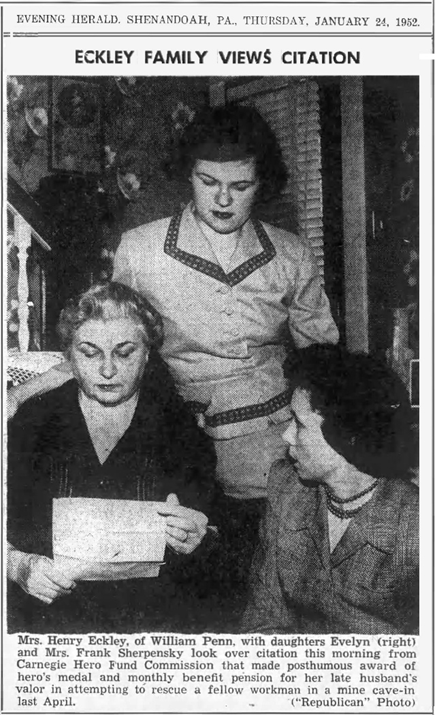
Details on how to contact the Carnegie Hero Fund Commission and how to explain details of accidents were outlined to the members of William Penn union Local 1398 at a meeting. The local forwarded the case to the Commission. Eckley was added to the Carnegie Hero rolls in January 1952, and Nora Eckley was awarded a bronze medal and a $60 monthly pension. The Evening Herald wrote:
“When the Carnegie Hero Fund Commission announced this week that Henry W. Eckley, Sr., of William Penn, died a heroic death, it must have made the family and friends feel pretty proud.
“A significant thing about the announcement is that nineteen awards were made by the Carnegie Commission and yet Mr. Eckley’s was the only one in the entire State of Pennsylvania.
“The William Penn man did not die trying to save a fellow worker. He did save him. Although disabled for six months after the mine fall, Mr. Eckley’s “buddy” recovered.
“There was a choice that fateful day for valiant Henry Eckley. He could have stayed in a safe place and waited for the stretcher bearers, or he could have gone to the “face” of the job where his “buddy” fell under a fall.
“We know what Mr. Eckley did. We knew it the day the accident took place. The William Penn Local Union knew it. Family and friends knew it. Now a nation knows it. It is men like Mr. Eckley who make and keep America great.
“Credit must go to the William Penn Local Union where Mr. Eckley enjoyed membership. This group brought the incident to the attention of the Carnegie Commission. An investigation was made and findings disclosed beyond doubt that Mr. Eckley was a hero.
“He could have stayed in the gangway.
‘“He didn’t. He went to his ‘fellow man’s” side.
“We bow in deep respect to the memory of a brave man.”