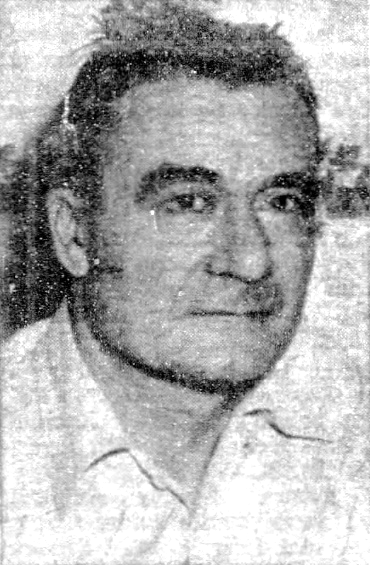
Amedeo “Paul” Pancotti (1908-1979) was born in Memphis, Shelby County, Tennessee, a son of Italian immigrants Nazzareno Pancotti and Ortenza Padmiere. The Pancotti’s returned to Italy soon after and Amedeo would return in 1926, He married Mary Tarantino of Exeter, Luzerne County, in 1934 and they had two daughters.
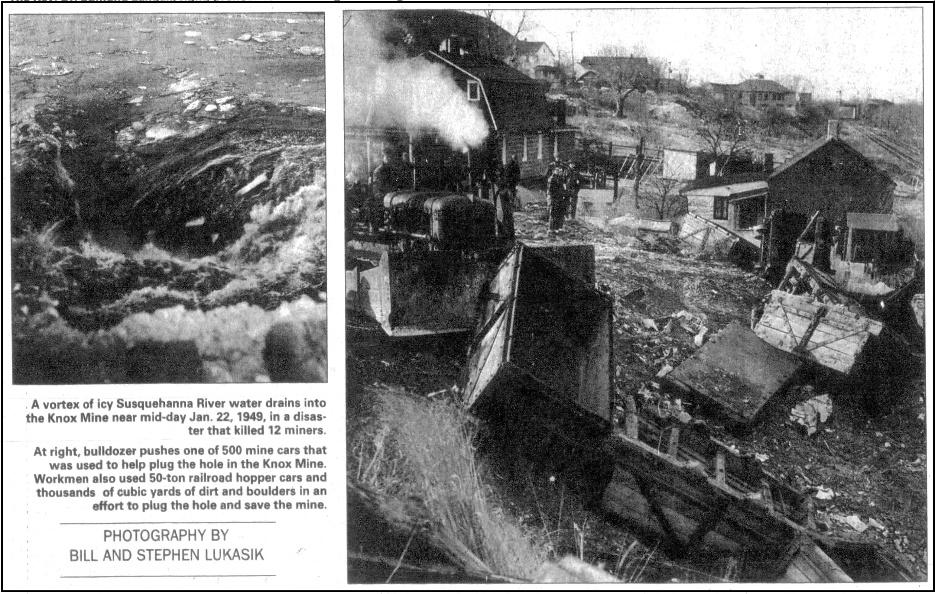
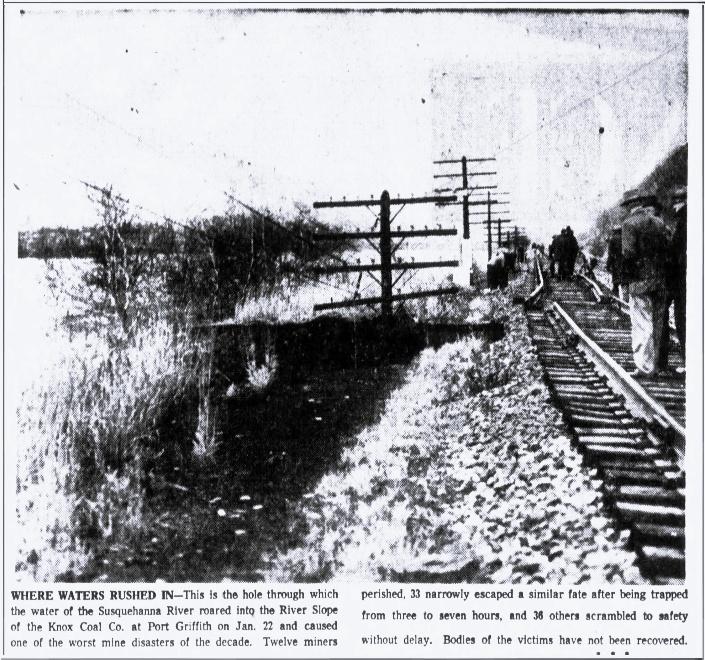
Pancotti and eighty other men were working at the River Slope Mine of the Schooley Colliery, operated by Knox Coal Company January 22, 1959. On January 22, 1959, a tragedy occurred at the River Slope mine, operated by the Knox Coal Company between Pittston and Port Griffith in Jenkins Township. Pa. It changed the future of the anthracite coal industry forever: The Susquehanna River broke through the thin rock roof over the River Slope workings. A whirlpool opened and government official began throwing railroad cars, coal waste, and anything else to stop the flood into the mine. The 81 miners heard a roar and felt air and water rush through gangways as the river poured in. Twelve men never came home. Miles of interconnected anthracite workings flooded, leading to the end of deep coal mining in the Wyoming Valley of Pennsylvania.
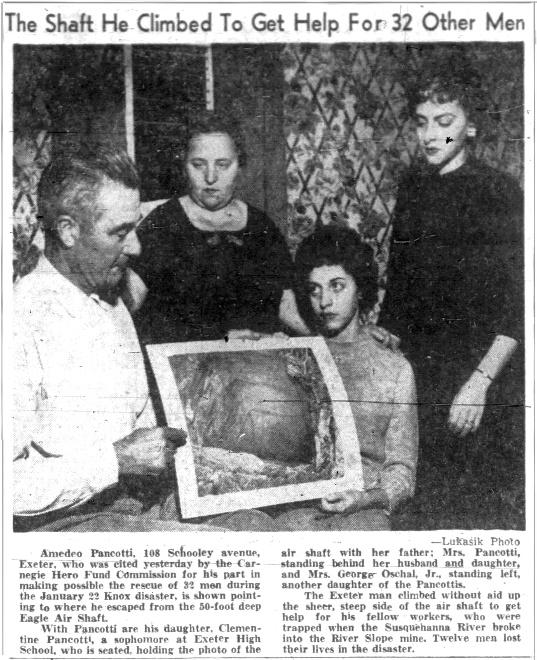
Some of the men escaped through an exit shaft before it was blocked by the rapidly spreading water. Pancotti and 32 other men rushed into an adjoining mine seeking an abandoned air shaft. He and six others separated from the group and reached the air shaft alone, only to find it blocked by debris.
Digging anxiously, Pancotti and three others cleared a tunnel through the 30 feet of debris. They found themselves some 50 feet below the surface, surrounded by the steep walls of the air shaft. Pancotti volunteered to scale the wall. Inching himself upward and taking advantage of every projection, Pancotti finally reached the surface.
He summoned aid and three men were raised to the surface immediately by a cable rigged to pull them out. A rescue team entered the air shaft and located 29 others who were taken from the mine to safety.
The complete US Bureau of Mines “Report of Major Inundation Disaster, River Slope. Mine May Shaft Section Schooley Colliery, Knox Coal Company” and pictures, can be found online at:
https://undergroundminers.com/knox-mine-disaster/
The Wilkes-Barre Citizens’ Voice published “The Knox Mine Disaster and the Pennsylvania Coal Company” January 21, 2012. an excerpt from Anthracite labor wars : tenancy, Italians, and organized crime in the northern coalfield of northeastern Pennsylvania, 1895-1959 which would be published in 2013. The book was written by Dr. Robert P. Wolensky, an adjunct professor of history at King’s College and trustee of the Anthracite Heritage Foundation, and William A. Hastie is a retired mineworker who was at the Knox Mine in January 1959. The excerpt gives some background on the Knox mine and its relationship with the Pennsylvania Coal Company:
“Twelve men died when the Knox Coal Company mined illegally under the Susquehanna River at Port Griffith, near Pittston. The victims were: Samuel Altieri, John Baloga, Benjamin Boyer, Francis Burns, Charles Featherman, Joseph Gizenski, Dominick Kaveliskie, Frank Orlowski, Eugene Ostrowski, William Sinclair, Daniel Stefanides, and Herman Zelonis.
“Fortunately, 69 workers managed to escape the billions of gallons of icy waters that coursed underground. Seven dodged icebergs for two hours under the leadership oi surveyor Joe Stella before finding the only available exit – the abandoned Eagle Air Shaft. Twenty-six others wandered for over seven hours under assistant foreman Myron Thomas’s direction before coming to the Eagle exit. Both the disaster break-in site as well as the air shaft have been clearly marked and can be visited along the new rails-to-trails path between the 8th Street Bridge in Wyoming and Cooper’s Restaurant in Pittston. The disaster site is a solemn place.
“While the immediate blame for the calamity has been rightly placed on the Knox Company and its owners Louis Fabrizio, John Sciandra, Robert Dougherty and August J. Lippi the crucial role of the Pennsylvania Coal Company (PaCC) should not be forgotten.
“For PaCC decided in the 1930s that the best way to boost profits was to lease coal veins and, eventually, entire collieries to a new breed of entrepreneurial subcontractor. The Knox Company was one such operation. It secured a PaCC lease in 1943 that granted access to coal at the Schooley Colliery in Exeter. In 1954, Knox took another lease for sections of the Pittston and Marcy veins at the Ewen Colliery in Port Griffith. The Knox disaster occurred in the Pittston vein when the company ignored the state-sanctioned ‘stop lines’ and removed the coal in a vein fatally close to the riverbed.
“Dozens of lease holding companies formed in the 1930s and 1940s to take advantage of a virtual underground land rush at PaCC. The agreements were issued mainly for so-called second and third minings, which involved “robbing the pillars” of coal remaining in a mine. The original miners left behind large blocks of anthracite to protect the internal structure of a mine. However, after the U.S. Supreme Court, in the famous ‘Penn Coal Case’ of 1922, held that the coal companies were blameless for any damage caused by surface caving, the hurry was on to remove all the pillars. Who led the charge in the court challenges to the existing laws regarding liability for surface damage? The Pennsylvania Coal Company.
“Many subcontractors and leaseholders at PaCC were well-known for disregarding mining laws, union-negotiated pay rates, and safety procedures. The miners referred to them as ‘butcher shops’ and ‘slaughterhouses.’ To make matters worse, many of the new lessee firms were owned by alleged members of organized crime, including the Knox Coal Company
“The mineworkers protested the often brutal and corrupt mining and labor practices at PaCC in a “labor war” that lasted between 1903 and 1935. In the final analysis, the workers could not overcome the powers aligned against them: the company, organized crime, and even the United Mine Workers Union which had become fully corrupt under the presidency of August J. Lippi between 1951-1965. Lippi’s secret and illegal ownership of the Knox Coal Company speak volumes about the woeful condition of the UMWA in the northern coal field.
“The sad fact is that the demise of one of the country’s first major business enterprises which employed over 180,000 men and boys at its peak in 1913, and as many as 24,000 men as late as 1959 involved not just ‘market’ competition from other fuels.
“It was also built upon malfeasance at various levels. Inadequate mining laws and weak state and federal mine inspectors did not help. And neither did coal operators such as the Pennsylvania Coal Company.”
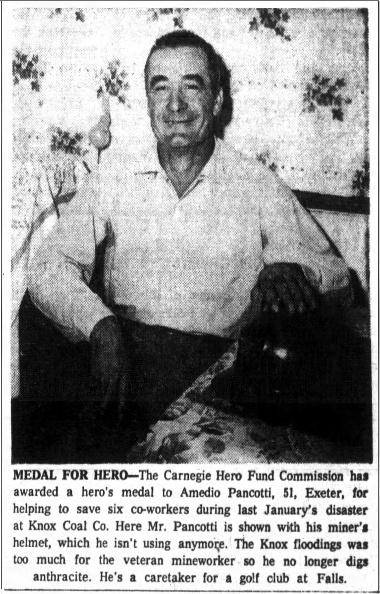
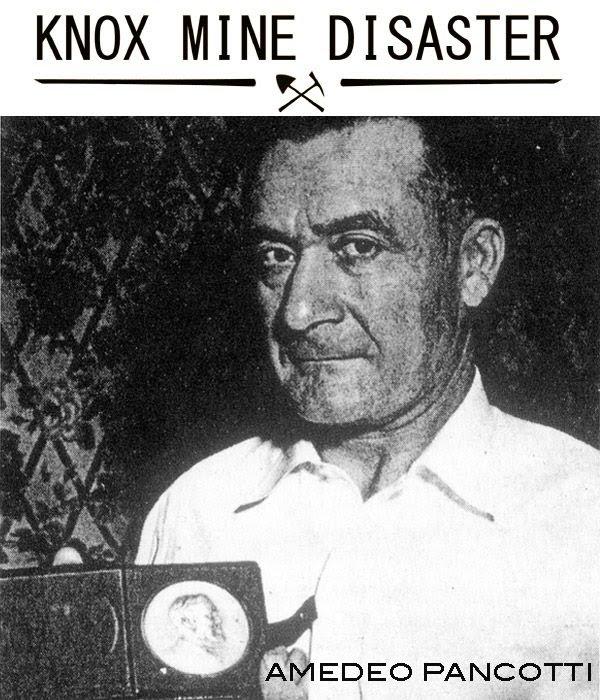
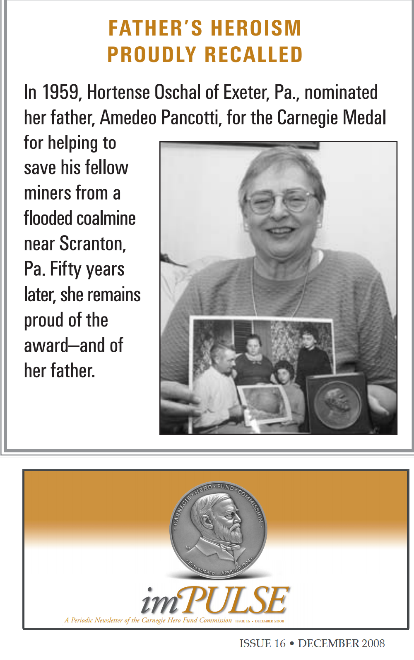
The Carnegie Hero Commission honored Pancotti with a bronze medal in October 1959. Describing his brush with death in the January disaster as “too close,’ Pancotti no longer worked in the mines. He was working as groundkeeper for the Emanon Country Club, Falls, Pa.. For 33 years before that fateful date, he had been employed as laborer or miner in anthracite operations. He started as laborer at Lehigh Valley’s Red Ash in Exeter at the age of 16, soon after returning here from Italy. Becoming a miner at the age of 22, he later was employed at Glen Alden, Pagnotti, Payne, and Knox Coal Company mines.
The Pennsylvania House of Representative paid tribute to Pancotti in November 1959, and he was awarded the Joseph A. Holmes medal of honor by the US Bureau of Mines in October 1960.He died May 21, 1979, and is buried at Italian Indepenent Cemetery, West Wyoming, Pa.