Clair S. Sigworth helped to rescue Peter A. Byczkowski from a mine cave-in, Wilkes-Barre, Pennsylvania, December 21, 1964. When a cave-in occurred in a coal mine, Byczkowski, 54, was pinned face down under eight feet of coal and debris. After another cave-in, the mine was cleared of all rescue workers, who by then had dug a tunnel six feet into the debris to find that Byczkowski was alive. Although further slides were anticipated, Sigworth, 53, mine inspector, and a miner made their way to the debris pile where Byczkowski lay partially in the tunnel, trapped by his legs. Sigworth crawled into the tunnel, which was so small that he had to lie on top of Byczkowski. Working as rapidly as possible, Sigworth removed coal from atop Byczkowski’s legs and passed it back to the miner. Additional coal fell as Sigworth worked, but he soon uncovered Byczkowski’s legs. While Sigworth rested outside the tunnel, the miner made repeated trips to obtain rescue tools. A mine foreman joined them. He and Sigworth took turns working to free Byczkowski’s feet; when either was in the tunnel, all of his body except his feet was beneath the debris. The foreman cut Byczkowski’s boots and freed one foot, the other remaining pinned by a heavy timber against the metal conveyor on the floor of the mine. Sigworth positioned a jack to move the timber, but it broke on use, and the foreman likewise broke a second jack. All three rescuers then worked to bend the conveyor, after which Sigworth pulled Byczkowski’s foot free, and he was removed from the debris then carried to safety. He recovered. The rescue had taken 2.5 hours. Several hours later another cave-in occurred in the area, and it required six days to uncover the body of a man who had been buried with Byczkowski. -48179-5023
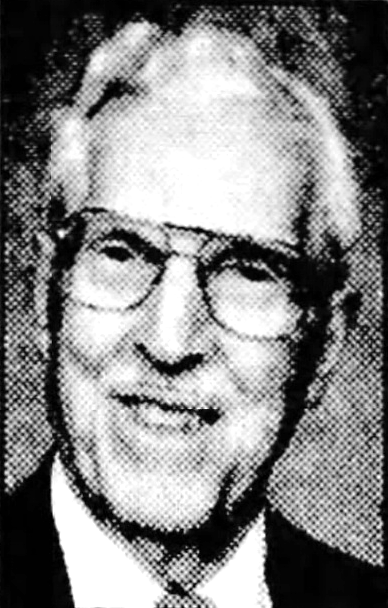
Clair Samuel Sigworth (1911-2001) was born in East Brady, Clarion County, Pa., and grew up in Brady’s Bend, Armstrong County, across the Allegheny River. He was one of eight children of Samuel Christopher Sigworth and Sarah Jane Wilson. He would marry Helen Neuman Hurd in 1952 while they both were working at offices of the U S Bureau of Mines in Wilkes-Barre, and they would have two children.
A cave in the Red Ash vein of the slope of the Franklin Colliery, Wilkes-Barre Township, occurred Monday December 21, 1964. Four men escaped the mine, two with slight injuries. Two men were trapped under rock and coal. More than 100 men soon came to help in the rescue, they were organized into 15-man crews digging and supporting the mine, because of the tight quarters. Three men, Frank DiAndrole, William Holena, 36, miner, and Clair Sigworth, 53, US mine inspector would rescue one of the men, Peter Byczkowski, 54. Congressman Daniel J Flood spoke about the rescue before the US House of Representatives Monday, June 21, 1965
“Acts of heroism in the coal mining industry have been well documented for generations. As the Representative from the largest anthracite-producing area of the world, I have personal knowledge of many of these heroic deeds where men will risk their lives in efforts to save the lives of their fellow workmen trapped beneath the surface of rock falls, gas explosions, passageways sealed off from the outside and for many other dangerous reasons.
“Just last December another in the long series of heroic sagas took place at the Franklin Colliery in the city of Wilkes-Barre where three men – Bill Holena, Frank DiAndriole and Clair Sigworth – risked their lives to save the life of one of their colleagues, Peter Buczkowski.
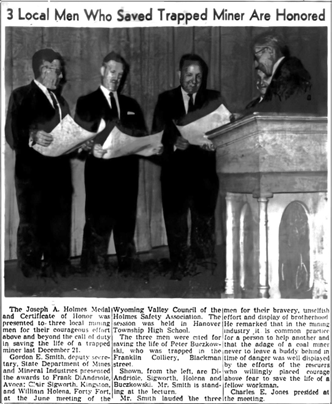
“In recognition of the bravery displayed on that occasion by these three intrepid miners, they will receive on Thursday, June 24, the Joseph A. Holmes Medal from the U.S. Bureau of Mines in Washington.
“I understand, moreover, that plans are already underway for them to receive consideration for the highest civilian award for bravery, the Carnegie Foundation Medal.
The Wilkes-Barre Sunday Indepent in its edition of June 13, 1965, featured a narrative of that heroic rescue and, Mr. Speaker, as part of my remarks today I would like to include that article. The article follows:
“FRANKLIN COLLIERY’S HEROIC TRIO TO RECEIVE MEDAL FOR THEIR DEED-FATHER OF SEVEN AMONG RESCUERS; ONE MINER KILLED
“It was a bleak December day last year when Bill Holena, of Forty Fort; Frank DiAndriole, of Avoca; and Clair Sigworth, of Kingston; got up for work.
All three were-and still are among the seemingly handful of men still employed by the anthracite industry.
“Bill and Frank worked as a miner and assistant foreman for Franklin Colliery, located off the Route 309 bypass near Blackman Street, city. Clair is a federal coal mine inspector.
“About 1:10 that afternoon it happened. A fall of rib coal at the Franklin workings killed one worker instantly and injured three others. One of these, Pete Buczkowski, of Plymouth, was entrapped by the falling debris. Larry Malachefski, 37, of Plymouth, was the killed miner. Al Kotch and Tony Saittawere the others injured. They were brought out by rescuers in a relatively short time.
“TIME WAS SHORT
The dilemma then was to free Buczkowski. Time was growing short since the vein near which he was trapped was constantly working, with small falls frequently occurring.
“Federal inspectors were wary about sending rescue teams in. Holena, DiAndriole, and Sigworth didn’t wait for an invitation.
“Despite orders by the Federal men on the scene not to reenter the mine, the trio did just that. “Holena’s venture was all the more reckless, it was thought at the time, since he is the father of seven children.
“For 2½ hours Holena, DiAndriole, and Sigworth battled the maze of fallen timbers, coal, and rock in their frantic efforts to free Buczkowski.
“TASK COMPLICATED
“Their task was complicated by the fact that the vein was pitched 69 degrees and several times they had to withdraw while smaller falls took place.
“Before they withdrew, however, they constructed a protective planking network around the trapped Buczkowski to ward off any further debris.
“Buczkowski, in obvious pain, repeatedly called for help. The three men once again ventured into the dangerous area, climbing over, under and around fallen coal, shale, rock, and timber.
“While coworkers installed timbers, braces, and cribbing against the active coal rib, Holena, DiAndriole, and Sigworth worked feverishly to free Buczkowski.
“ANOTHER FALL IMMINENT
“Another fall in the area was imminent as the timber creaked under the additional weight. “Undaunted, Holena, DiAndriole and Sigworth kept digging, tugging, and shoveling.
“Buczkowski was conscious all the time and finally, 10 hours after the original fall, he was freed from the materials which pinned him and which had him on the precipice of death during all that time.
“Four hours after Buczkowski was rescued, another large fall occurred at the point of the original cave, the resultant rubble being so extensive that it took 6 days of timbering and reopening work on four shifts a day to recover the body of Malachefski.
“The official report of the accident fixed the cause as failure to recognize the hazardous condition presented by the thin separation between the top and bottom red ash vein, Excessive width of the ‘place’ was a contributing factor.
“OPERATIONS CEASE
“The mining operation at Franklin Colliery has since ceased, but the heroic deed of Holena, 37; DiAndriole, 55; and Sigworth, 54, hasn’t been forgotten.
“On June 24, at Hanover Township High School, they will receive the Joseph A. Holmes Medal from the U.S. Bureau of Mines in Washington.
“Friends of the trio hope this is but the first step toward recognition of their unselfish efforts. Plans are already underway for application to the Carnegie Foundation for that group’s heroism award.
“LEAST IMPRESSED
“But the three men are probably the least impressed of anyone with the news of their impending decoration.
“They know all too well that there have been many instances of similar heroism in the anthracite industry in days gone by – incidents which the average miner considers no more than his duty.
“They also know there are many instances when the heroes never returned to tell about their exploits deep in the bowels of the anthracite area’s earth.
“But, while medals tarnish and memories dim with time, there’s one guy who’ll never forget what those three men did during those 10 dark hours-Peter Buczkowski.
The Franklin Colliery was located near the southeastern corner of Wilkes-Barre. At one time it was called the Blackman Mine. Eleazar Blackman (1765-1843) moved to Wilkes-Barré in 1773. Later, he lived on a farm in Wilkes-Barré near the Hanover Township line and not far from the foot of the mountain. He opened a “coal-bed” on this farm in the 1820s, and for several years he carried on in a small coal business in addition to his farming operations. In time Blackman’s mines became known as the “Blackman Mine.”
About 1829, Edwin Horn Jones (1844-1908) and his brother John Henry Jones (1839-1864), from the mining regions in Wales came to Blackman’s mines. They opened the first underground mining in this part of the country, and perhaps the first in the United States. With the North Branch Canal finished up to Hanover and Plymouth at the same time, the Wyoming Valley coal business really commenced.
Asa Packer (1805-1879) founded the Franklin Coal Company in 1858 and acquired Blackman Mine. Franklin Coal Company operated the Franklin Colliery until March 1889. The Lehigh Valley Coal Company leased the colliery from Franklin Coal’s owners, the Asa Packer Estate and the Lehigh Valley Railroad. LVCC operated regularly until 1930, when they operated for only 120 days, and shut down in April, after running for only 27 days in 1931.
Louis Joseph Pagnotti Sr. (1894-1966) incorporated the Franklin Coal Mining Company in 1941. Pagnotti leased the property and operated a deep mine and strippings on the property, processing the run-of-mine coal at other Pagnotti coal preparation plants. The lease expired in 1945, and Lehigh Valley reclaimed the mine, with Pagnotti working the strippings. Coal was sent to LVCC Prospect Breaker for processing. They operated again until only working 35 days in 1953 and “suspending” operations. At least 52 anthracite mines were shut down in the 17 months ending Junen 1953, with 7,600 men idled. 250 of those were from Franklin. With no plans of reopening, LVCC leased the property to Alco Mining Company, and the small independent operator sunk a slope on the south side of Franklin Colliery and mined the slope and strippings with 11-20 men in 1955-1957.
Lehigh Valley Coal Company leased the Franklin property in 1957 and most of its other coal lands to Pagnotti interests in April 1959. Pagnotti Coal Company and Coal Heat and Pitreal corporations, companies organized by Pagnotti Coal Co., purchased the coal lands and business of Lehigh Valley Coal Company in October 1963. They operated Franklin mine and stripping with subsidiary No. One Contracting Company in 1857-1961, and with Lehigh Valley Anthracite, Inc. 1962-1964.
In 1964 the Franklin mine produced 23,855 tons of anthracite with 99 men working 202 days.
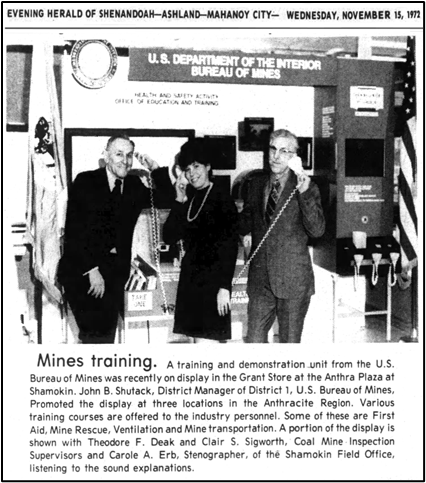
Sigworth went to school in East Brady until 11th grade and went to work as a laborer. He started work in the mines in western Pennsylvania bituminous in the 1930s, advancing to assistant mine foreman at Allegheny River Mining Co,, Kittanning by 1940. He was a mine foreman when he was drafted into the Army Air Corps in 1943, serving in the European Theatre, and involved in the Battle of the Bulge and the Anzio invasion. He was discharged at the end of 1945, and may have spent time in the mines of north east West Virginia, as he was in Winchester Virginia in 1947. He joined the U.S. Bureau of Mines as a mine inspector in Wilkes-Barre and remained there until about 1970. He then became an inspection supervisor at the Shamokin office, where he stayed until retirement in 1975 from MESA, the Mine Enforcement Safety Administration. In 1973, the Secretary of the Interior had created MESA as a new departmental agency separate from the Bureau of Mines. MESA assumed the safety and health enforcement functions which had been done by the Bureau. Clair and Helen retired to Lancaster and then Lititz, Sigworth died June 3, 2001. He is buried at the Concordia Lutheran Cemetery, in Columbia, Lancaster County.
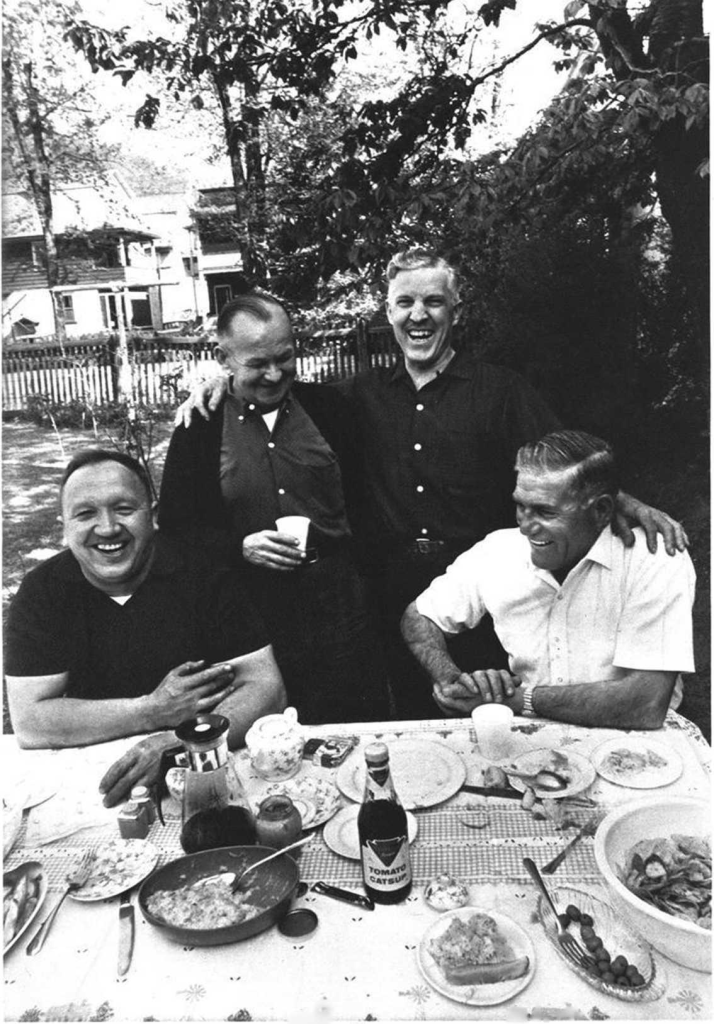
Esquire magazine published a photo essay entitled “Nine Heroes’ in its September 1967 issue. William Paul Holena, Clair S. Sigworth, and Frank Di Andriole with Peter Byczkowski at a reunion picnic, laughing. The photo’s caption read:
“A coal mine caved in at the Franklin Colliery, Wilkes-Barre. Pennsylvania on December 21. 1964, trapping Byczkowski and his brother-in-law under coal and debris eight feet deep. Everyone else got out. After a second collapse, the mine was ordered clear of all rescue workers: the risk was too great. By this time, however, the rescuers had learned that Byczkowski was still alive, his brother-in-law dead. In spite of the warnings and the virtual certainty of further cave-ins. Sigworth, a mine inspector, and Holena, a miner, decided to get Byczkowski out if they could. To reach him they made their way among the temporary supports to a ten-foot area between the end of the passage and the pile of debris under which Byczkowski was pinned, face down. His legs were caught under heavy timbers, his upper body free. There was just enough room for Sigworth to lie on top of him and remove the coal covering his legs, passing it back to Holena. Although they did manage to uncover his legs, Byczkowski’s feet remained caught and it was not until the two men, joined by Frank Di Andriole, had made repeated trips through the trembling mine with hydraulic jacks and other tools that they got the man free. Two hours later the gangway of the mine collapsed, and it took six days to find the body of Byczkowski’s brother-in-law. The reunion is photographed in Sigworth’s backyard, a rather ordinary looking group of American men—Heroes — as all these photos have shown, can look much like anybody else. And. like anybody else, the hero is concerned with himself: ‘I could never have lived with myself if I hadn’t tried to help that man.’ said Sigworth. You see? Just like the rest of us.”