

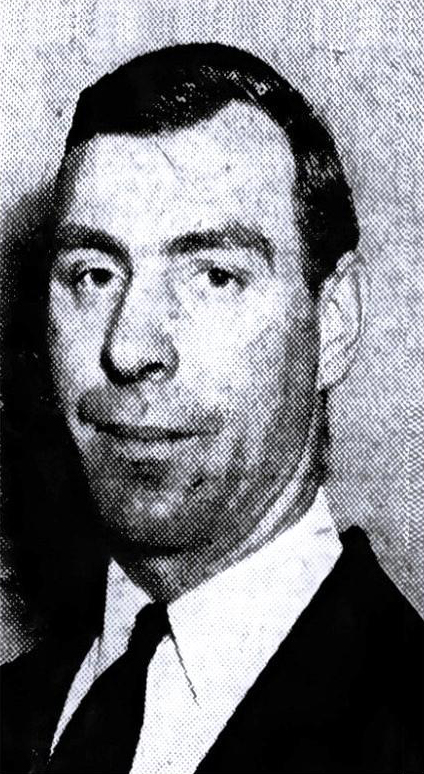
Henry Robert Skibitski (1911-1972) was born in Dickson City, Lackawanna County, Pa., one of at least four children of Polish immigrants John Skibitski and Sophie Gerulski. He married Michalene J Soter, daughter of a Dickson City Polish miner in 1934, and they had three children.
Skibitski and John Kuchinski, 37, Dupont, Pa., were working as miners at Jermyn-Green Coal Company’s No. 6 Colliery at Inkerman, Jenkins Township, Luzerne County, Pa., on March 30, 1943. A mine train run by Michael Novobilski, Dupont, ran away on an air-course of the mine, two cars derailed, causing the roof to collapse for 17 feet in the air-course and in a crosscut at one end of the cave-in. Novobilski was unhurt, but Andrew “Tonto” Swierczewski, 45, miner, Duryea, was killed by the cars, and Frank Chas, 44, mine laborer, was trapped by caved rock and mine timbers. Henry and Kuchinski crawled around the cave and worked together for some 2½ hours to free Chas, endangering their own lives. Chas was hospitalized at Pittston for about a month and after his discharge did not return to his former job.
The two were added to the Carnegie Hero Fund roll of honor and awarded bronze medals and a cash award in January 1944. Skibitski was taken by complete surprise when he was informed by the Scranton Tribune of the award. “I hadn’t heard anything about It,” he said. He quickly recalled the act of heroism and explained that the heavy timber had pinned Chas face downward. “He thought he was there six or seven hours, but I don’t think it took more than two hours to get him out.” He told how they had dug under Chas, letting him fall slowly downward. “Then I pulled him out by the legs,” Skibitski added.
The January 27, 1944, Tribune also reported that:
“The hero was at work as usual yesterday and was just home for the evening meal when he received the joyous news. ‘I certainly appreciate it a lot,’ he explained, his voice evidencing the pleasant surprise which had come to him. He said he was looking forward eagerly receipt of the medal and the official notification from the Carnegie Commission.”
The two men received a Joseph A Holmes Medal of Honor at November 1946 banquet sponsored by UMWA Local 7499, employees of No. 6 Colliery. Kenneth Alfred Lambert, Sr. (1895-1972), president of the coal firm, was toastmaster at and speakers included mine inspectors and union officers and Thomas Maudlin Beaney (1905-1973), colliery superintendent at the time of the accident. Union members gave each of the men two $100 savings bonds. The men also had been honored previously by the company.
The Pennsylvania Coal Company opened No. 6 Colliery about 1854 and built a new No. 6 breaker at Inkerman in 1898. About 1,500,000 ft of lumber was used in its construction. The capacity of the breaker was 1,800 tons per day while the combined pocket room was about 1,500 tons. The coal prepared at this breaker was mined at Nos 5, 6, and 11 shafts, mining the Checker, Pittston, Marcy, Clark and Red Ash Seams. The company sunk No 6 shaft 557.7 feet, the deepest in the Pittston district. The Company became the Pittston Coal Company in 1930, and they operated with many financial and labor problems until 1935.
Volpe Coal Company, owned by Santo Volpe (1879-1958), a Pittston gangster; sublet the colliery in September 1937 and hired many of Pittston’s supervisors and miners. The breaker was shut down, and products from the colliery, and later strippings, processed at Volpe’s Butler breaker in Hughestown. Volpe Coal Company was sold to the Jermyn-Green Coal Company in March 1943. Production of No. 6 in 1943 was 472,556 tons, with 809 men working 282 days.
Jermyn Green failed in June of 1949 and shut down operations. Eight hundred employees of the Number 6 Colliery, Inkerman, were owed approximately $300,000 in wages. Jermyn Green Coal Company sold the idle mine to Louis Joseph Pagnotti Sr. (1894-1966), owner of Number Nine Coal Company. Pagnotti also leased No. 6 from Pennsylvania Coal Company and would operate until 1954. In 1955 John Boyle McDade (1897–1976) and his brother Joseph P McDade (1904-1960), owners of the Heidelberg Coal Company and lessee of the Butler Colliery, formed the Inkerman Coal Company. Inkerman operated No. 6 mine until 1959.
Skibitski was a coal miner for fifteen years, a coal loader in 1930 at 19, and a miner at the Eddy Creek Colliery in Olyphant in 1940. Eddy Creek had flooding and labor problems in the early 1940s, and its likely he was new at No. 6 at the time of the accident. The family moved to a farm at Shupp Hill in Tunkhannock Township, Wyoming County, Pa. He died at home after an illness April 16, 1972. Henry is buried at Pieta Catholic Cemetery, Tunkhannock.