

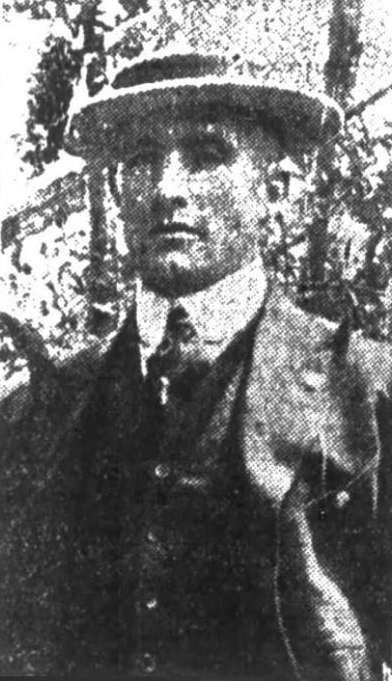
Joseph Patrick Riley (1890-1955) was born in Sugar Notch, one of at least five children of Patrick F. Riley and Sabrina Riley. He married Estella Claire Stella Mahon of Plains, Pa. in 1919, they had one daughter, Margaret.
A group of boys were picking huckleberries August 4, 1924 on the mountainside above Sugar Notch, over the No. 9 Colliery of the Lehigh and Wilkes-Barre Coal Company. Later in the day, when one of the boys, Chester Stavinski, had not returned home, his parents queried the other boys, who said they had seen him near a large cave over an abandoned section of the mine. A search party was formed, and several workers from No. 9 Colliery joined, one of whom was Joseph Riley.
The cave-in hole the boys pointed out was four feet diameter and about 200 feet deep. Riley volunteered to look for him and was lowered with a rope to the bottom of the hole. He retrieved Stravinski and the boy was taken to the hospital. The boy had a fractured skull and did not live long.
Early mining in Sugar Notch was done in the area about 1840 by Samuel Holland (1783-1856) and partners. The first shafts were sunk in 1855 but were too shallow to make much coal. The shaft was sunk to the depth of 360 feet to an eleven-foot seam of coal in 1864 by the Wilkes-Barre Coal & Iron Company, controlled by Charles Parrish (1826-1896). Gangways were driven, pumps put in, breaker built, and Sugar Notch No. 9 was put into operation, with a capacity of about 800 tons per day. The Lehigh and Wilkes-Barre Company took over the property in 1874.. The No. 9 Colliery was towards the west end of the borough, and the L&WB’s Sugar Notch No 10 Colliery Just outside the borough’s north east corner. In 1924 Sugar Notch No. 9 produced 436,640 tons, working 278 days with 892 men. Sugar Notch No. 9 would be owned by Glen Alden Coal Co. in 1930,. The Colliery was closed in 1933. Mining would continue with coal being prepared at other Glen Alden breakers. Blue Coal Corporation would take over the mine in 1966, and close it in 1970.Riley was working as a driver in a Sugar Loaf coal mine before he was 19. He enlisted in the Regular Army in December 1917 and reported to Company C 49th Infantry Regiment at Fort Slocum NY. It moved to France in July 1918 and was attached to the 83rd Division 12 August 1918, providing replacement personnel for front-line units. Promoted to corporal, he returned to the US in January 1919 and was discharged in February 1919. He returned to Plains, where his wife was living with her parents. Returning to Sugar Notch, he started as a laborer, working on mine track at Lehigh & Wilkes Barre Sugar Loaf No. 9. He continued working as a laborer for Glen Alden, he was at its South Wilkes Barre Collery in 1942, and they were living in Wilkes-Barre. They moved to Waukegan Illinois about 1948, where Joseph worked at a Veterans’ Administration hospital. He died at the VA Hospital July 20, 1955, and is buried in the Annunciation Cemetery Waukegan.