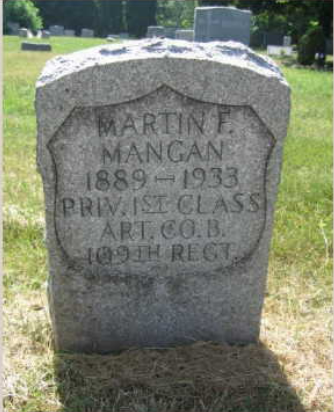
Martin F Mangan (1889-1932) was born in Pittston Pa., one of at least nine children of Nicholas Trancis Mangan and Margaret Greeley. He never married.
He was working as a shaft footman at the Hoyt Shaft, Ewen Colliery of the Pennsylvania Coal Company on January 10, 1911, when an explosion of an undetermined source occurred. A coroner’s inquest held in June 1911 was unable to determine the cause of the explosion, but it was believed blackdamp, a mixture of carbon dioxide and nitrogen, ignited.
The Hoyt Shaft was located near the Susquehanna River between Port Blanchard and Port Griffith. Hoyt Shaft was 532 feet deep, mining the Checker, Pittston, Marcy and Red Ash seams. The shaft, sunk in 1886-1887, was originally called No. 5 Shaft. In 1911, 330 men and boys were working at Hoyt Shaft, and the Pennsylvania Coal Company was using it to access mines across the Susquehanna River. The Ewen Colliery prepared and shipped the coal mined at Hoyt Shaft. The Pennsylvania Coal Company Gravity Railroad, from Port Griffith to Hawley, 47 miles, was the first rail facility in the area. The colliery and shaft were named for Brigadier General John Ewen (1810-1877) and George Allen Hoyt (1811-1887) were early presidents of the Company. Hoyt Shaft and Ewen Colliery gained some infamy in 1911 when Lewis Hines photographed boys working in the mines and breaker there.
The afternoon of January 10, 1911, Patrick Bulger, a company man, was sent to build a wall to direct the air current up to a counter gangway above, where Frank Kleish, laborer, was working. Mathew Daily, 45, company man, was cleaning the road on the counter gangway. An explosion occurred in the gangway. The morning fire boss failed to discover any gas in the workplace. The supposition is that Bulger had about completed the wall that directed the air current up into the abandoned breast where gas had accumulated when the gas was carried into the face of counter gangway and ignited by the open light of Frank Kleish, who was the only person burned. Daily was suffocated by the afterdamp, Kleish died January 12 and Bulger died January 25. from injuries received due to the concussion. Five miners, Anthony Gowrey, 43, Inkerman; Joseph Lucas, 33, Port Griffith; James Dougher, 27 and Owen Redington, 66, both of Pittston were also working in the area.
Fellow workmen at the foot of the shaft heard a tremendous noise and they saw dust flying in all directions. They feared a catastrophe and as soon as the turmoil subsided, a relief party headed by John T. Brown, 46, mine foreman, and James Conion, 36, assistant mine foreman, started for the chamber where the explosion occurred. The rescue corps also included Andrew Devers, 54, miner; Thomas Gallagher, 25, car-runner; Andrew Horan, 44, miner; Michael Madden, 37, assistant mine foreman; Martin Mangan, 26, mine footman; and Jacob Modla, 22, mine driver.
The rescue corps went into a heading of a coal mine, one-half mile from the shaft, immediately following the explosion that had deflected the air current and filled that and other headings with afterdamp. They wore no respirators, only scarves over their faces. The Wilkes-Barre Semi-Weekly Record wrote, “The relief party hurried into the mine, and pressing forward with as much speed as possible in the face of the deadly black damp and obstructing doors and brattices which had been blown down, they finally reached the first of the stricken party who was Joseph Lucas.”
Finding Lucas unconscious, they carried him into fresh air. Returning, they found Dougher, whom they also carried out. All had been somewhat affected by the afterdamp. The men went through another heading into the gangway where the explosion had occurred, where they found Gowrey. A second explosion seemed imminent, but Brown stayed alone with Gowrey until the others brought a stretcher. While the men carried Gowrey out, Brown continued through the gangway until he found Kleisch and carried him out. Lucas and Dougher were revived, Gowrey was badly burned, and Kleisch died from his burns.
William P. Jennings, Pittston district superintendent of the Pennsylvania Coal Company brought the miners deeds to the attention of the Carnegie Committee and in October 1911, Martin was awarded a Bronze Medal and $1000 by the Carnegie Fund. Six of the others were also added to the honor roll and awarded medals and cash, and Thomas Gallagher was added to the roll and got awards in April 1912.
Martin began working in coal mines in the 1900s and worked in various laboring jobs in the mines until his death, except for a period during World War I. From May 1916 until May 1919, Mangan served in Battery B, 109th Field Artillery. Troops from the 109th in Wilkes-Barre fought in almost every major war in American history. Starting with the Revolutionary War, then the Mexican American, the Civil War, World War One, World War Two and as recently as the Iraq War. The 109th was formed October 17th, 1775, and was one of the oldest battalions, one of the oldest regiments in the United States. It was divested in 2025, 250 years old. Mangan was made a sergeant in 1917 and went to France with the 109th from May 1918 until May 1919, serving in the 109th’s engagements of Oise-Aisne, Ypres-Lys, Meuse-Argonne, and Fismes-Vesle.
He returned to Pittston and was listed as working as a laborer in the mines in both the 1920 census and 1930 census.
Martin was struck by an automobile while crossing a Pittston street and died on May 28, 1932, and is buried in Saint John the Evangelist Cemetery, Pittston.