

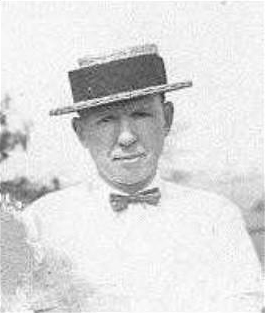
Michael James Franklin (1882-1936) was born in Ireland, a son of Patrick Franklin and Mary Langan. He came to America at the age of 2, with his mother and older brother. He married Adelaide Mokes of Browntown, Pittston Township in 1922, and they had two children.
Michael J. Franklin, aged 37, a mine track layer; Edward. F. Norton, aged 33, a mine laborer; and Patrick J. Gallagher, aged 43, a mine track layer of the Browntown section of Pittston Township, helped to save Sylvester William McKeon, aged 12; and Robert Emmett Fear, aged 13; both of Browntown, from a mine cave-in at a bootleg mine hole at Browntown on May 18, 1917.
Michael J. Franklin helped to save Sylvester McKeon and Robert Fear. Fear and McKeon entered a mine slope from a hole that had caved in the ground and entered the chamber of an abandoned mine of the Pennsylvania Coal Co. “to gather coal”. They were caught by a fall of earth overhanging the entrance to the chamber, and Fear was buried to his chest, and McKeon was buried to his hips. Cracks at the top of the hole and the dropping of clay earth overhanging the chamber indicated another cave-in was imminent. Norton descended the hole to McKeon and Gallagher descended the hole to Fear and each tried to dig the boy out with his hands. Franklin descended the hole with a shovel and help dig McKeon out, using the shovel. When McKeon was free, Franklin took the shovel to Gallagher and helped rescue Fear.
Robert Fear recovered and grew up and became a dentist. He lived until 1971, leaving a widow, two sons, two daughters, and six grandchildren. Sylvester McKeon recovered and grew up, changing his name from Sylvester William to William Sylvester. He died in 1976, leaving two sons, two daughters, eleven grandchildren and six great-grandchildren.
Franklin was awarded a bronze medal, No. 1489, and $1,000 for “a worthy purpose, as needed”. The awards to Gallagher, Norton, and Franklin were made in October 1919.
The 1893 History of Luzerne County Pennsylvania, H. C. Bradsby, Editor, describes Browntown as,
“a mining place in Pittston township, on Pennsylvania coal company leaseholds. It joins Pittston on the east and extends toward the D. & H. Canal Company railroad; bounded on the north by a line from Fairmount breaker to Market Street and on the south by an extension of Swallow Street to the D. & H. Canal Company railroad. It is supplied with water by the Pittston Water company; has an estimated population of 1,000, in 200 dwellings, engaged in the mines.”
Browntown perhaps was named for Newman Brown (1799-1879), farmer, an early settler in that neighborhood. The coal and all the property was owned by the Pittston Coal Company, leased to the Pennsylvania Coal Company, and all the housing either belonged to the Company and leased to the miner’s family or were houses placed on leased property. The Company’s mining under Browntown was done from the No. 4 Shaft, an early work of the PCCo. Henry Darwin Rogers and the First Pennsylvania Geologic Survey visited the Pittston and Port Griffith works of the PPCo in 1854. The existing openings and part of his descriptions was, “Shaft No. 4, immediately south of the Pennsylvania Company’s office, a depth of 100 feet with coal 76 feet below the surface.” By 1917 only pillar robbing was the only legal mining happening under Browntown.
Coal Age magazine, April 17, 1917, reported,
“Several homes were wrecked and the main roadway of the town caved in on April 5. The cave extended entirely across the street to a depth of about 40 ft. The water main burst and the continuous flow of water and loud rumbling of caving earh caused people to run in all directions for fear they would be engulfed. It is said the subsidence is due to taking out the pillars in the No. 4 shaft of the Pennsylvania Coal Co.”
and in the December 15 issue of that year wrote,
“Mine caves menacing the property and lives of three families on Brown St., notice was served upon the residents by officials of the Pennsylvania Coal Co. to remove their dwellings. It is believed that the surface settlings result from the breaking of the roof in workings of the No. 4 shaft where it is said the company is robbing pillars as the quality of coal at that point is good. Most of the dwellings in this town are erected on ground leased from the company and occupants have no regress, they state.”
Subsidence is not exclusively a Pennsylvania problem. It occurs in most of the mining areas of the world. In most places the subsidences happen under unused and vacant land, and effects on the public are little noticed. However, in northeastern Pennsylvania, notably Pittston, the area is densely populated and the consequences are striking.
Beside much of the land being undermined by Pennsylvania Coal Company, small leasehold mines and illegal “bootleg” mines had been worked in the area, all close to the surface. It was likely that one of these was the hole that the boys were playing in.
Michael had been a bartender before he married and then got a job as a track layer for the Pennsylvania Coal Company, which he held until he died of a heart attack September 6, 1936. He was stricken while on his way home from a baseball game at Sullivan Park in Pittston. The game was between the Kehoe-Berge Colliery and Stanton Power Plant teams and won by the latter, Franklin was a Power Plant rooter. The photo above is of Michael at a ball game. He was buried in the St. John the Evangelist Cemetery, Pittston.