Robert Hughes (1884 -1942) was born in North Wales, United Kingdom, one of at least eight children of William Robert Hughes, a coal miner, and Jane Williams. They came to America in 1884 and settled in Avoca. He married Mary Craig of Moosic, Pa. in 1907 and they had at least five children.
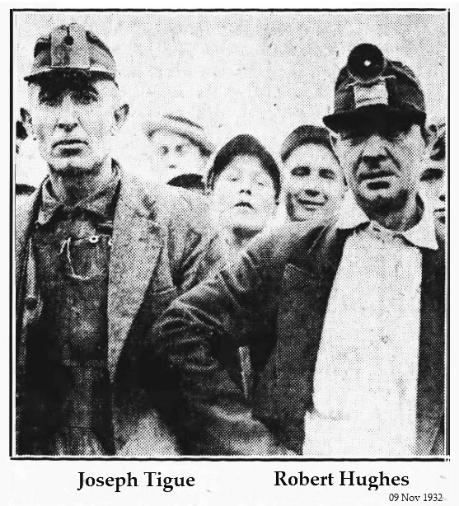
On November 8, 1932, Robert Hughes, aged 50, a miner at the Ewen Colliery of the Pittston Coal Company, married and father of three children and his friend Joseph P Tigue, also a miner, were at home in Avoca Pa. Lucky men, they had jobs when most anthracite mines had been closed by the Depression. Ewen miners worked 203 days that year, more than any future year in the 1930s. Many of their contemporaries were “bootlegging coal.” Bootleg mines generally were small mines dug by a handful of men, clandestinely on land owned by a coal company.
On that day, Thomas Ambrose “Hick” Coleman and Louis Doran, unemployed miners, and another man were working at a bootleg mine in the Houston City patch of Avoca, on the east side. It was on the property of the Quinn Coal Company, northeast Avoca, close to what had been the Hillside coal breaker, near today’s Wilkes-Barre Scranton Airport. Coleman and Doran, neighbors of Hughes and Tigue, were working in a coal hole they had dug into the abandoned mine workings, a chamber about 12’ x 12’ in the March vein, about 40 feet underground. When they pulled a good-sized chunk of coal from a pillar, a cave occurred and tons of rock and soil fell, trapping the men.
James Lester, the man on the surface operating a windlass hoist, felt the ground shake when the cave happened and went to get help. Men from town soon gathered with picks and shovels, and began cutting logs to support the roof, but no one volunteered to enter the mine until Hughes and Tigue said they would, went home and got their mining gear and were lowered down the opening.
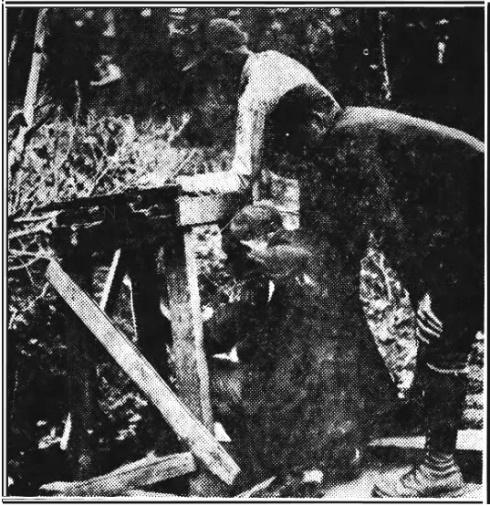
They found Coleman nearly standing, nearly buried by rock and soil, but able to talk. When they asked where Doran was, Coleman said, “Here he is, right under me”. They searched on their hands and knees, finally finding Doran, completely hidden by the cave material. They used their hands to dig debris from his face and put some loose boards over it to protect it from sloughing dirt or other caves. Doran talked to the men.
Shovels were lowered and they dug for several hours to get Coleman out. When “Hick” was nearly loose, tying a rope around him and tugging until everything was free except his boots. Another rope was tied around him, and he was pulled up using the windlass apparatus, taken to the hospital, where he recovered, with a big bruise from being pulled out of his boots. He was released from Moses Taylor Hospital, Scranton, a week later and lived until 1966.
Hughes and Tigue took a break, returning to address Doran. Doran cried, “Hurry up and get me out of here!” Working, in shifts with others and together, into the night, they finally went home for sleep and returned the next morning. Again, working with others, Hughes and Tigue uncovered Doran, who was freed about twenty-eight hours after the cave. Doran was conscious and had eaten and drank water during the rescue. He smiled as he was lifted from the mine-hole. Doran would die from shock and his injuries that evening at the Moses Taylor Hospital. Hughes, Tigue, and other members of the Rescue Crew were pallbearers at the funeral.
The land where the accident happened was controlled by Quinn Coal Company and had been the Hillside Coal & Iron Company Consolidated Colliery, which started in 1885. The land and the breaker were leased in 1924 by Thomas F. Quinn (1875-1955). Quinn Coal shut the breaker down in 1930 and lease the mine to Scranton Anthracite Coal Company. Thomas Quinn was an official of Scranton Anthracite also. The Colliery was abandoned in 1935.
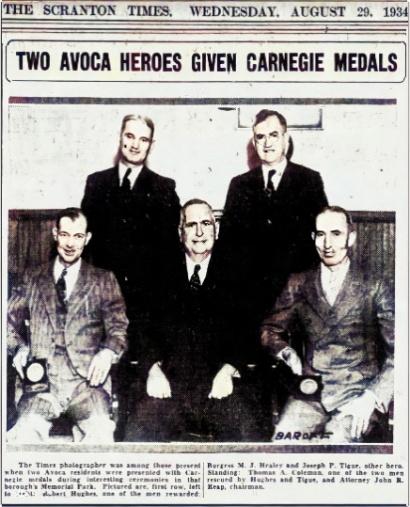
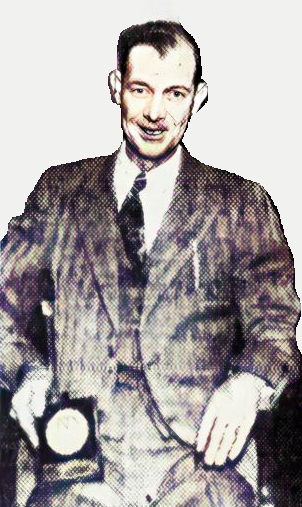
Hughes and Tigue were added to the Carnegie Hero honor roll in April 1934, and they were each awarded a bronze medal and $1000 at a public ceremony that August. Coal Company and public officials spoke, and Thomas Coleman was there.
Robert, age 16, and his younger brother William, 14, were listed as a mine day laborers in the 1900 census. Their father was a coal miner, and a younger brother David, 12, was not working. Robert was a coal miner in 1910, 1920, 1930, and was reported as a mine laborer on his death certificate. Hughes died December 6, 1942, at home, and is buried in the Langcliffe Cemetery, Avoca.