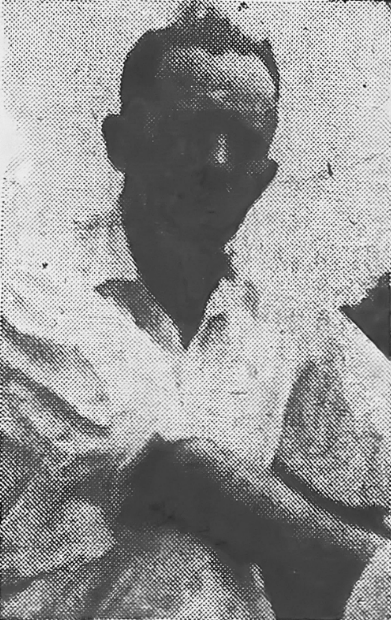
William Jerome Kelly, Sr. (1900-1949) was born in Shenandoah, Pa., one of the twelve children of Irish immigrant, John J Kelly and his wife, Margaret “Maggie” O’Leary. He married Ruth Mary Hennessy of Shenandoah about 1939 and they had three children.
Kelly, 49, chargeman of Shenandoah; Joseph P. Wowak, 34, chargeman , of Shenandoah; and Raymond J. Eye, 38, mine laborer, of Girardville died attempting to save William T. 0’Brien, 53, mine fireboss/night foreman, from suffocation at the Gilberton Coal Co. Packer No. 5 mine, Girardville May 3, 1949.
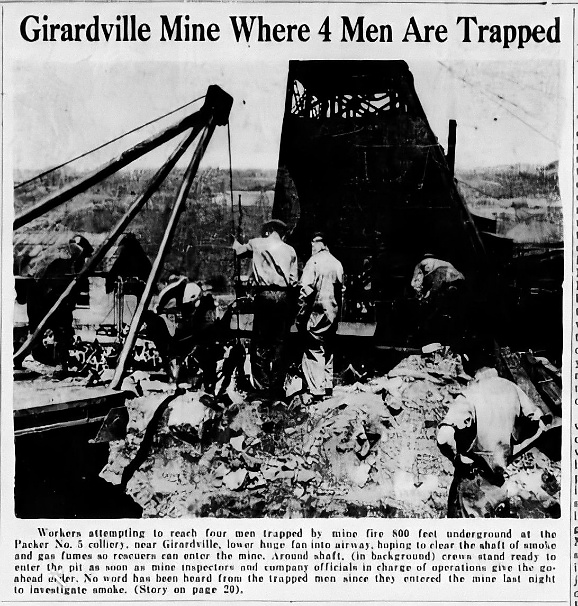
Gilberton Coal, which had leased the mine from the Stephen Girard Estate in 1947, was in the process of extending the shaft from 500 to about 1,000 feet. After the dayshift miners were done, an evening crew would come in to do work associated with the extension, which was in its latter stages. The crew was William O’Brien, Raymond Eye and Michael Caulfield of Girardville; Thomas Woods of Lost Creek; Theodore Andrews of Upper William Penn; and William Kelly, Joseph Wowak and Ed Biddle of Shenandoah. Additionally, four “rockmen” were in the vicinity at the time, working to make a new gangway. It wasn’t known exactly when the fire started, but the rockmen apparently were the first to get some whiffs of smoke. The rockmen were hoisted to the surface and reported the fire in the mine.
O’Brien, who was the night foreman, was making his daily fireboss checks and had gone down to the third and fourth levels, according to Woods, who was interviewed by a newspaper reporter after he was rescued. The other seven on the second level had just sat down for their lunch when they got whiffs of smoke that began to grow stronger. Kelly, Wowak and Eye took a fire extinguisher and went in search of O’Brien to report a fire in the mine, according to Woods’ account.
Woods, Biddle and Andrews accompanied them to the top of the Orchard Slope. Eye, Kelly and Wowak boarded a car at the landing and Woods operated the engine that dropped them down to the third level. They immediately signaled Woods and said, “The air is clear down here and there is no smoke or evidence of fire. We are all right.” Caulfield, a few minutes later, said: “I can’t stand the smoke boys. We better head for the shaft.” Within minutes the second-level gangway had filled with heavy clouds of smoke. The heat’s intensity also increased, leading to confusion and frantic efforts to get out. It was impossible for any of those remaining at the higher level to stay at the engine to operate the car that lowered the others. “We had to go on our hands and knees along the tracks” to get to the main shaft and cage in which they would be hoisted to the surface, Andrews said later. “We managed to get there and ring the bell for the cage to be hoisted but then passed out.” The next thing he remembered, Andrews said, was regaining consciousness upon getting to the surface. Woods, Biddle and Caulfield were with him. O’Brien, Kelly, Eye and Wowak remained in the mine.
Apparently the three men found O’Brien somewhere on the third level. Some said they might have scattered inside the mine in search of the blaze.
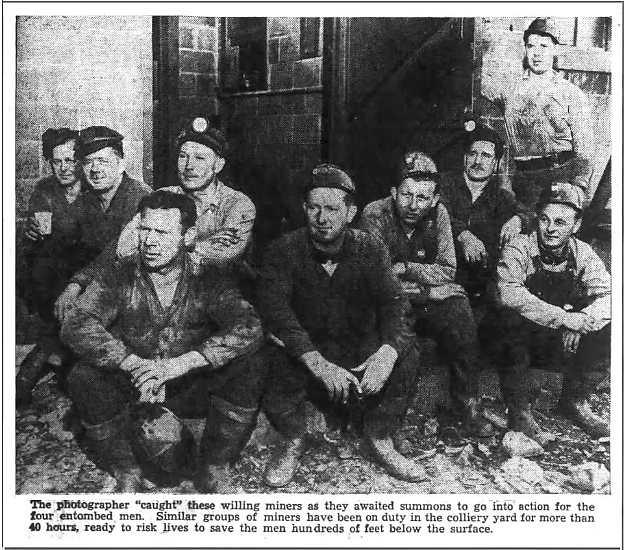
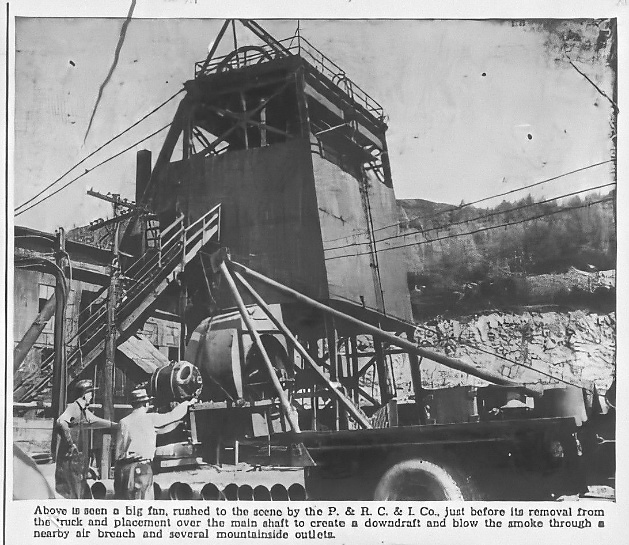
During the rescue operation, crews tried various methods of using large fans to clear the smoke from the shaft, all to no avail until a huge fan was hauled from the Centralia Mining Co., Centralia, which, like Gilberton Coal, was owned by John Rich of Pottsville. It was described as a desperate attempt to clear the smoke to allow crews to get into the mine, and when Rich told the Centralia miners their operation would have to be shut down to remove the fan, they agreed wholeheartedly.
During the rescue operation, crews tried various methods of using large fans to clear the smoke from the shaft, all to no avail until a huge fan was hauled from the Centralia Mining Co., Centralia, which, like Gilberton Coal, was owned by John Rich of Pottsville. It was described as a desperate attempt to clear the smoke to allow crews to get into the mine, and when Rich told the Centralia miners their operation would have to be shut down to remove the fan, they agreed wholeheartedly, Barrett reported.
To dismantle, transport it, and reassemble it, took 10 hours. It was an operation that would have taken two weeks under normal circumstances. By the evening of Thursday, May 5, the smoke was cleared sufficiently to allow a team to go down even though the mysterious fire itself continued to burn.
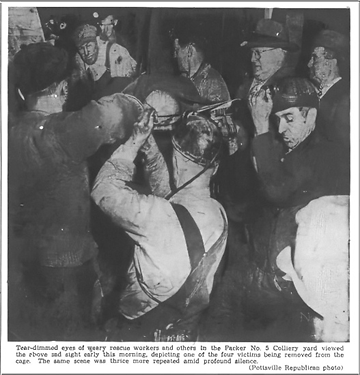
The four trapped miners were together, their bodies found at what was called the Orchard Slope at the mine’s second level, some 50 hours after the fire broke out. They apparently gambled on getting to the shaft – the quickest way to the surface – but were overcome by smoke and carbon monoxide.
The Maple Hill mine rescue team retrieved them. The fire itself continued for days as crews pumped water into the mine to flood it. It was said the fire apparently started when a piece of timber fell, knocking down electrical wires that hit the rail and set a main junction box ablaze.
The St. Vincent de Paul Society of the Shenandoah Annunciation of the Blessed Virgin Mary parish submitted details of the incident to the Carnegie committee in June. The St. Vincent members suggested that Kelly, Wowak, and Eye had the choice of being hoisted to the surface or of searching for William O’Brien, who was deeper inside the mine. They said they felt the acts were worthy of investigation for possible consideration by the Hero Fund Commission.
Bronze medals and death benefits were voted in October to the survivors of Eye, Wowak, and Kelly. Eye’s father George was awarded death benefits of $40 a month. Wowak’s son and daughter, Joseph Jr. and Mary Ann, were awarded $20 a month each, and Kelly’s widow was awarded. $60/month
The property the Packer 5 mine was on was leased by the Girard Estate to Jeremiah Seitzinger (1814-1903) and George Washington Huntzinger (1825-1883) on July 1, 1863. Seitzinger and Huntzinger developed the property and erected a breaker which was called the Colorado Colliery, its first shipment in 1865. The lease was transferred to the Philadelphia Coal Company in 1867, and in 1874 the Lehigh Valley Coal Company bought Philadelphia Coal. About 1884 Lehigh Valley opened new tunnels to the coal seams lying above and below the Mammoth and erected a new colliery, Packer No. 5. Colorado, then known as Packer No. 1 colliery, was taken down during 1885, and all coal mined on this lease after was mined through Packer No. 5. The Lehigh Valley Coal Company continued operations on this lease until 1939 when East Bear Ridge Coal Company, a subsidiary of Temple Coal acquired it.
Rose Valley Coal Company was started in 1945 by Pasquale “Tony Rose” Adonizio (1881-1954), a Pittston coal operator. Tony Rose at one time operator of nine collieries in the region. Girard Estates leased Packer No. 5 Colliery to Rose in March 1945. It was worked on a steady schedule until February 1947, when it was suspended for a rehabilitation program on the fourth level. There was also a dispute over “lost wages” at the time. In October 1948, John Baptist Rich (1893-1978), president of the Gilberton Coal Company, acquired the Packer 5. It closed in 1959.
Kelley went to eighth grade in school and went to work at Packer No. 5 as a footman. He worked for a time as a carpenter in the building industry around 1930 before returning Packer 5 as a carpenter before 1940. He is buried at the Annunciation Blessed Virgin Mary Church Cemetery in Shenandoah.