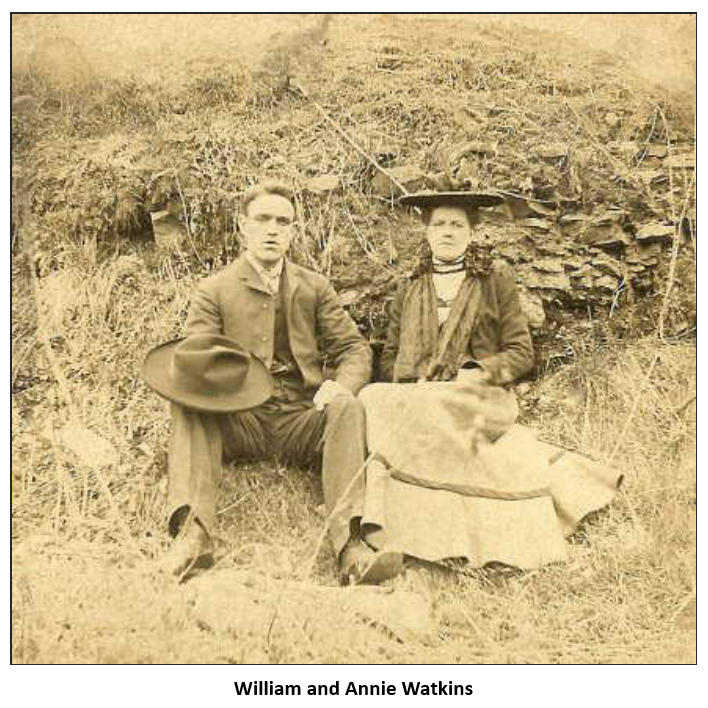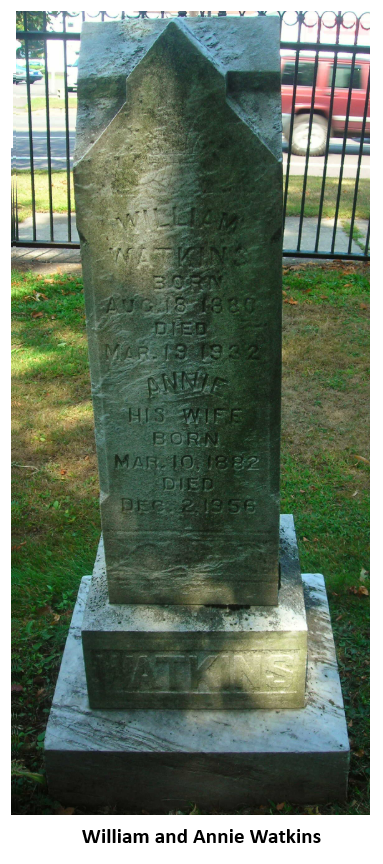
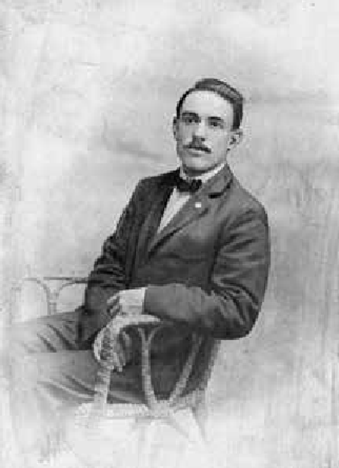
William Henry Watkins (1880-1932) was born at Ferndale, Glamorgan, Wales, one of fourteen children of William James Watkins and Mary Ann Bishop. He came to America in 1887 and married Annie Williams of Edwardsville in 1900. They had two children, Davis and Daniel.
He was working as a laborer at No. 4 Colliery of the Kingston Coal Company, Edwardsville, Pa. in 1904. The No. 4 shaft of the Kingston Coal Company was completed in 1883 upon reaching the Red Ash seam at a depth of 616 feet. In 1884, a second opening was effected by opening into the workings of the Kingston No. 3 shaft. A breaker was erected in 1885 and 1886, with shipments beginning in October 1887. It was a very large structure, built with a view of preparing the coal of the Ross and Red Ash seams. It was heated with steam, a new feature in coal breakers. A replacement breaker was built in 1891, after the first burnt. Electric haulage was installed in 1900. The colliery also had slope and drift openings. In 1904, 730 men and boys were working inside.
On September 3, 1904, when a gas explosion occurred. He was working about 300 yards from the explosion and heard a slight noise and felt a rush of air. He and many others rushed for the surface, but before he reached the shaft, he realized there might be injured men who might need help, so he stopped and turned back.
Upon finding the site of the explosion, in a section of the mine known as “Pugh’s Slope”, he also found thick afterdamp and blew out his lamp. For the next three-quarters of an hour he faced death by afterdamp or cave-in, the explosion had knocked out the props that supported the roof-rock. Proceeding in the dark, he heard groans and first came upon Joe Winchent who was burned and helpless. While Watkins carried him to safety, Winchent told Watkins that there were others further down the slope.
Watkins went back for them. He encountered Brinley Davis wedged under a shattered car, worked to release him and took Davis to safety. Hearing another cry for help, Watkins returned to find young Rees Williams badly injured. Watkins got him to safety shortly before the roof of the slope fell in. The three rescued men related this story to the New York Herald, while Watkins demurred, saying that “All that I did was my duty.” The rescued men all returned to the mines.
In November 1904, George Tennyson Matthews (1846-1932) and the New York St. David’s Society awarded Watkins a gold medal for heroism and bravery and submitted his incident to the Carnegie hero fund committee. In 1906, Watkins was awarded a silver medal and $1,200 to liquidate the indebtedness on his property by the Carnegie Hero Fund Committee. It was said he was “greatly surprised’ by receiving the award.
Later, Watkins would move to Plymouth and Kingston. He would work as a slope engineer at the D L & W’s Loomis Colliery and for a number of years worked as a foreman in the Pine Ridge Colliery of the Hudson Coal Company.
He would die at age 54 from pneumonia at Kingston Pa March 19, 1932, and buried in the Forty-Fort Cemetery. The Wilkes-Barre Times March 19, 1907, wrote:
“All honor to William Watkins, of Edwardsville, miner and hero. His fellow citizens and his county is proud of his achievement and heartily congratulate him upon being a recipient of one of the Carnegie silver medals. The intrinsic value of the medal is very little, but it’s worth must be measured by the fact that it was only granted after a severe investigation. Mr. Watkins is not the only hero in the mining regions and among the miners. There are hundreds of others, but he is typical of his race, and his fellow workers. Hence we wish him health and long life to enjoy his honors and trust his companions and fellow workers may have less and less cause every year to perform similar deeds of daring because of better protection in the shape of more inspection and improved methods of mining.”